


It’s crazy that this movie exists. How is everyone not talking about it all the time
Directed by Herbert Ross
During the Great Depression, a sheet music salesman seeks to escape his dreary life through popular music and a love affair with an innocent schoolteacher.
Pennies from Heaven is showing in 1 cinema in Los Angeles - next screening Wednesday 20 January at 19:30 at Academy Museum of Motion Pictures.
Next screenings: Wednesday 20 January.
Full schedule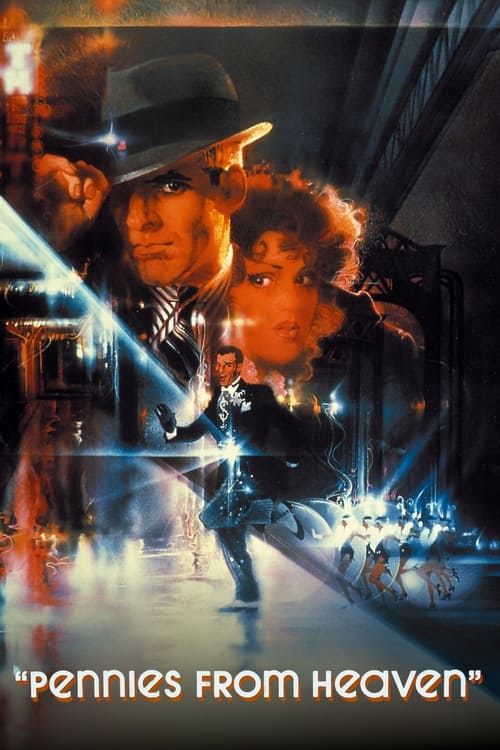
Pennies from Heaven showtimes, refreshed every morning
Pick your cinema, get a nudge before it leaves screens.
It’s crazy that this movie exists. How is everyone not talking about it all the time

never in my life have i been so conflicted over a film. never! i loved this, and i hated it, and so i gotta do the only thing i can in a situation like this, and nut it out through bashing my keyboard until even the smallest something starts making sense.it's tempting to say that the emotional side of my brain loved this and the analytical side did not - but that would be the epitome of an oversimplification. instead, what happened was that my perpetual predisposition to be intrigued by love and intimacy got rather violently hamstrung, repeatedly, until it became impossible to separate the elements of pennies from heaven that i loved from the ones i abhorred. this film is an anachronism wrapped in circular chronology: conceptualised in the 70s, released in the 80s, set in the 30s and guided in equal parts by the 20s and 50s, pennies from heaven's cauldron of influence is so full that its gravitational pull has the unfortunate side effect of vacuuming up any consistent morality too. here we arrive at the main immovable problem with the film: not only is it deeply misogynistic, but, worse, the misogyny goes entirely unacknowledged and is therefore normalised to the point of actively harming - physically and mentally - every single female character. every single one. it's something i'd expect of a film from the actual 30s, not a film that's only 36 years old. (a warning: the next paragraphs will discuss the sexual assault and murder of women by men, please feel free to skip or stop reading if you need to.) arthur, the protagonist, is skin-crawlingly revolting. he repeatedly tries to force himself on his wife, then complains relentlessly when she won't have sex with him - and the film has the gall to use this as the establishing point for the audience's expected sympathy for arthur. dissatisfied, he proceeds to flirt with another woman who is quite clearly afraid of him, then he STALKS HER TO HER HOUSE, where he sits and "dithers" about whether or not to GO INSIDE TO THE HOUSE OF A WOMAN HE HASN'T EVER ACTUALLY PROPERLY MET AND INSTEAD FOLLOWED HOME. when he does, this stalking behaviour is normalised, presented as sweet and devoted. he begins pursuing the woman - eileen - lying to her about his marital status the entire time, before eventually sexually assaulting her, which he also does under false pretences by pretending his wife is DEAD and using her "death" to elicit sympathy. but SURPRISE SURPRISE the film doesn't think it's sexual assault! because a woman actively saying "no!" several times means she secretly really wants it! not that the man is completely blinded by his own desire to the point of rape! WHY DO MEN KEEP WRITING THIS TERRIBLE CONTENT INTO EXISTENCE I WILL NEVER UNDERSTAND AS LONG AS I LIVE. anyway that made me FURIOUS and ordinarily i would've either quit right there or given it an extremely low rating - something which a very overwhelming chunk of me still really wants to do, by the way - but alas, i can't simplify pennies from heaven down to its abhorrences and then move on, as much as i may want to do exactly that.arthur continues his misogynistic behaviour throughout the entire film, and - just as reliably - the film continues to normalise it, praise it, present it as "romantic." here, clear as day, is the grave reality born of that pernicious "boys will be boys" mentality: an entitled adult with the materiality of a child, who treats women as things he can leave lying around, damaged and strewn about like forgotten toys. this kind of behaviour is only ever done out of the entirely male expectation that either another man will come and tidy up out of the goodness of his heart, or that these women-objects will be stepped on and snuffed out for good. i wish it were as simple as saying: but the women didn't let that happen! they picked themselves up and they carried on in spite of everything, and that showed those men! those men, who reformed their ways and apologised for their behaviour, or showed some awareness that it may have been wrong, or - at the very, very least - were punished somehow for their appalling attitudes. but the reality is that women do suffer, and die - for example, there's a bizarre, needless and extremely upsetting murder about an hour into the movie of a disabled woman, committed by a man the narrative has been actively empathising with and humanising - and they suffer and die at the hands of misogyny. in that way, pennies from heaven reflects the chaos from which it was born, and while that isn't a justification for its laziness in acknowledging this toxicity, it is, on some level, a mirror of reality.in the end, it's the perpetuation of harmful misogynistic attitudes - which are imbued irreparably into this narrative - rather than their representation that is the worst and most unforgivable part of this film. already established character traits of female characters are directly contradicted by the blatantly male need - both behind the camera and in front - to manoeuvre these women into positions, activities and dialogue that are solely constructed to please men. that this need for control can go so far as to alter the very core of consistent character writing is ... it's so bad. good lord. there's no good side to that. it's bad forever.however! that is not to say that pennies from heaven is devoid of any depth and complexity. quite the opposite, in fact. honestly, if you've read this far and all you can conclude is that you never want to touch this film with a ten foot pole, then i both respect and am a tiny bit envious of you. forgive me.but now i've established that i hate this movie, i can go into what made me love it: it's brilliant. it's so smartly constructed, and it's so intelligently referential that i couldn't help but get entirely swept away several times. its timelessness works always in its favour; obviously coloured by the darkness of the great depression, it still manages to sit comfortably in the spaces between eras, finding instead a sense of understandable fullness that i couldn't help but admire. what it said about connectivity and romance - even when romance is entrenched in damaging internalised misogyny - was fascinating. warm at turns, then icy cold, the range it employed to examine that yawning chasm between two very close people, between projected personalities and steadfast actuality, between dreams and reality, unearthed some true profundities.the totally bamboozling musical nature of the film - having all the actors lip-sync with music from the 20s and 30s instead of actually sing - threaded imagination and reality into one another, eventually weaving those two opposites into a truly symbiotic symphony. the scene where eileen and arthur mimic fred astaire and ginger rogers gave me CHILLS, and this might actually be my favourite scene in the history of cinema. these musical numbers are arrestingly outlandish, and unapologetically so - each one conjures up roughly the same sensation as looking at a painting and suddenly realising its actually a 1000 piece jigsaw puzzle, so clear and complex is their mosaic. tangentially - holy shit is this a well shot film. its frames have almost as much subtext as a film like carol, and everything from the lighting to the framing is meticulously considered in order to expand upon the (largely unspoken, at least directly) yearnings of the characters. also the dancing!!!! THE DANCING!!!!!!!!!!!!!!!!!!!!!i also loved eileen. hampered though she is by the achingly awful treatment she receives at the hands of men, she's got a hell of an arc. bernadette peters (yes, obviously i watched it for her, get it out ya system) captures that most difficult of contradictions, steely vulnerability, entirely without fault. and this intensely textured woman, who is angry and quiet and loud and soft, only adds to the contradictions this film steadily continues to wrap itself in from start to finish. she's a wonder and a disaster, and this would be a perfect film if it were about her instead of arthur the deadbeat dickhead. but this is where i finally come back to emotional responses. i couldn't find it in me to care at all about the main romantic relationship, so blatantly one-sided as it was, but i REALLY cared about eileen. whether that's because peters is just That Good - which she is - or because i'm just magically inclined to pay unwavering attention to women on screen is, for once, largely irrelevant, because eileen is so magnetic that the actual what of her falls away to be replaced with the overwhelming how. she's a mess of her own hopes and dreams for herself, and beyond that, whole chunks of her identity are simultaneously all tied up in how she's perceived by others - an involuntary product of masculine-controlled femininity, i should point out. as a result, she actually becomes BOTH the emotional and rational focal point of the movie, as well as the one part that'll age well (obviously in terms of feminism/morphing morality but also, like, physically. she's so beautiful it's nuts). she is a living collection of divergences; and that, paradoxically, is a universally human state.in the end, i can't in good conscience recommend pennies from heaven. it's too disturbing, too lazy, too downright misogynistic and dangerous to warrant that kind of blind endorsement. i will, however, say that, despite being difficult and disappointing and disturbing, pennies from heaven is also rewarding, inventive and resonant. i'm conflicted, but i'm at peace with that conflict. it won't ever go away, and that's good - it's healthy to confront art that i both love and hate, and conclude that it's okay for me to go on simultaneously loving and hating it. complexity cannot ever be accepted as an excuse, but it can be a mirror, and a mirror always reflects two things: hope and reality.

This really has to be seen to be believed. It’s best to go in blind
During the Great Depression, a sheet music salesman seeks to escape his dreary life through popular music and a love affair with an innocent schoolteacher.
Herbert Ross directed Pennies from Heaven in 1981, adapting a BBC television drama by Dennis Potter.
Pennies from Heaven is rated R in the US.