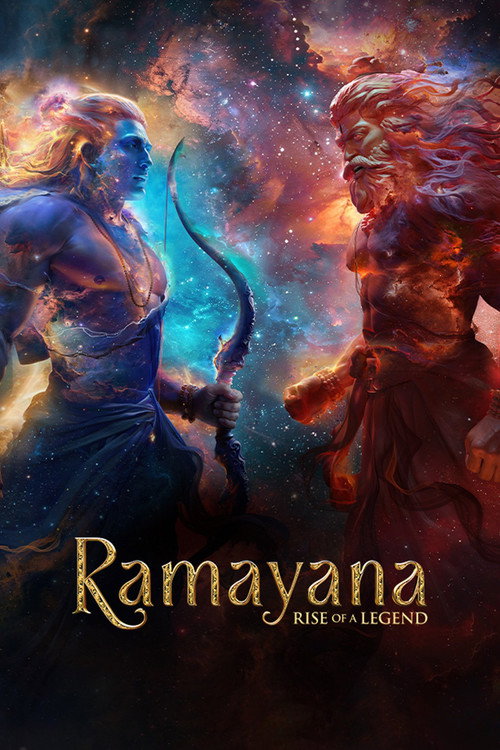
The trailer gave me high hopes, but the actual film completely blew me away. With its massive scale and epic world-building, this genuinely feels like India's answer to The Lord of the Rings. Seeing it on the big IMAX screen was everything I wanted and more.
(HINDI VERSION) - GO SEE THE HINDI VERSIONIf you're planning on seeing Ramayana, please do yourself a favor and watch the Hindi-language version instead of the English-dubbed version. I'm so serious. I've now seen this movie twice, and somehow the Hindi version made me love it even more. The AI lip-syncing in the English version didn't really bother me at the premiere, but after seeing both, the difference is noticeable. And more importantly, the Hindi version is 3 hours and 15 minutes long, while the English version is only 2 hours and 45 minutes. That's 30 minutes of additional material, including musical sequences and songs that are shortened or removed from the English version. And after experiencing both, I genuinely don't understand that decision. When I say Ramayana feels like a combination of The Lord of the Rings, The Prince of Egypt, The Lion King, and Princess Mononoke, I'm not exaggerating. I absolutely love this movie. But what really stood out during my second viewing was how beautifully it balances its different tones. In many ways, it feels like three movies coming together. The first part is defined by the chaos of Ravana, the second by the calmness of Ram, and the third by the collision of those two worlds. And I love how the filmmaking reflects that difference. Ravana's world is aggressive, unpredictable, and overwhelming, while Ram's is patient, peaceful, and deliberate. Even the camera movements, music, and action sequences reflect their different relationships with power. I've seen people criticize the slower middle portion, but I actually think that pacing is essential. We need that time to understand Ram, his relationship with Sita, and everything these characters stand to lose. Without those quieter moments, the spectacle wouldn't carry nearly as much emotional weight. And that's why cutting material from the English version is so frustrating. Those musical sequences and character moments aren't simply distractions. They're part of the film's cultural identity, emotional development, and storytelling. The Hindi version gives everything more room to breathe, and the payoff is that much stronger because of it. I already loved Ramayana, but this second viewing has completely solidified my obsession with it. It's a richer, more emotionally satisfying experience, and I genuinely want people to see this film in its fullest form.
Watched in the original Hindi Adapting the Ramayana for modern cinema is probably the highest-stakes gambit in Indian film history, especially after how burnt audiences were by recent VFX-heavy misfires. But Nitesh Tiwari actually pulled it off. He understood that grandeur means nothing if the emotion isn't rooted in genuine reverence and restraint. First off: watching this in Hindi is definitely the way to experience it. The cadence of the dialogues strikes a very delicate balance—it avoids sounding stiffly archaic while keeping the lyricism, dignity, and weight you expect from sacred text What worked so brilliantly: Ranbir Kapoor’s Rama: There was a lot of skepticism around this casting, but Ranbir completely sheds his usual urban restlessness. His Lord Rama isn't played as a loud, superhuman conqueror; he is quiet, rooted, and profoundly observant. The stillness and warmth in his eyes during the vanvaas sequences give the film its moral gravity. Sai Pallavi as Sita: She brings an effortless grace and grounded vulnerability. Her chemistry with Ranbir feels sacred and timeless rather than melodramatic. Yash’s Ravana: The energy shifts completely whenever Lanka enters the frame. Yash plays Ravana with terrifying, regal magnetism. He doesn't just do a comic-book villain turn; there’s tragic arrogance, intellect, and sheer physical presence. The Rahman × Hans Zimmer Score: Hearing A.R. Rahman’s classical, soulful orchestration weave into Zimmer’s signature low brass and wall-of-sound percussion gave me goosebumps. It elevates key mythic beats into pure cinemaVisuals & Worldbuilding: The scale here is unprecedented. Ayodhya feels lived-in, the forests are lush and tactile rather than glowing plastic CGI, and the creature/demon designs have actual textureVerdict: A monumental achievement in Indian mythic filmmaking. It respects the soul of the epic without treating it like a hollow tech demo. Catch it on the biggest screen possible, in Hindi, with the sound turned all the way up.