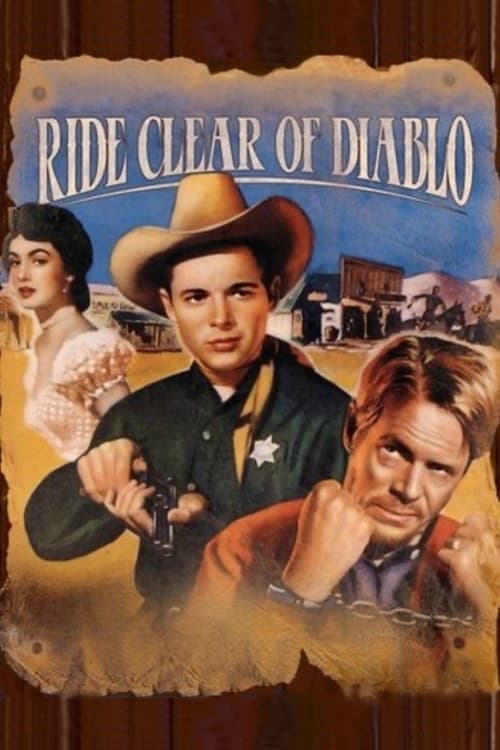


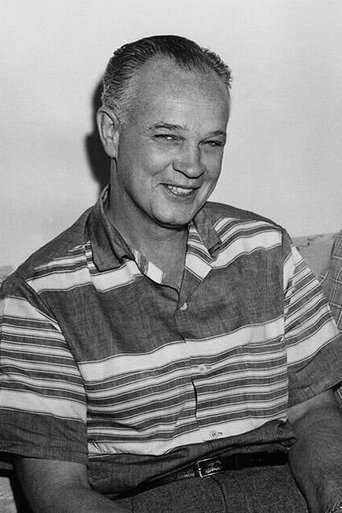
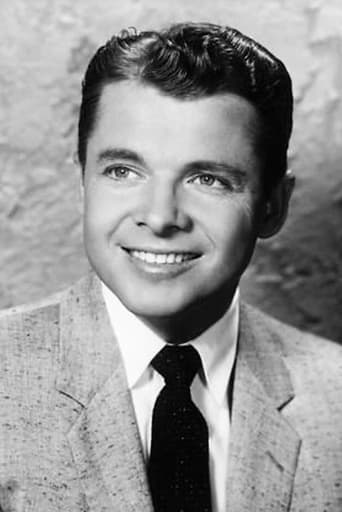
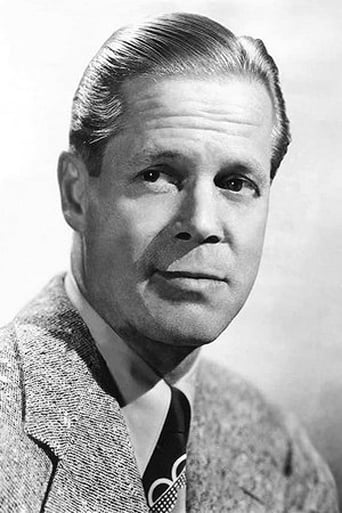


Prior to 1954, Jesse Hibbs had directed just a single movie: a football drama starring Tony Curtis, to which Hibbs was no doubt assigned because of his past playing football at USC. Clearly Universal liked what they saw, though, because Hibbs quadrupled his output the following year, directing four tight, efficient westerns for the studio. Of those four pictures, two of them (Rails Into Laramie and The Yellow Mountain) are very focused on outward masculinity, both in appearance and behavior, as well as on relationships between men. Ride Clear of Diablo — Hibbs' first film in 1954, and his first western — is something of a different animal.Rather than concern itself with big, blustery, physically dominant men, Ride Clear of Diablo instead focuses on what's inside, and the way unassuming packages can hide boundless bravery and resolve. Its hero is Clay O'Mara, played by Audie Murphy with a subtle flintiness, and a quiet, physical confidence that's easily — and often — overlooked.O'Mara's brother and father were murdered by cattle rustlers, and he's taken a leave from his railroad job to return home and track down their killers. He tries to act tough and hard when he approaches the sheriff for a deputy's badge, but it's a performance that falls entirely flat (he gets his badge despite the unconvincing performance, for reasons he doesn't find out until much later). Later, when he's sent to track down the notorious Whitey Kincade (Dan Duryea) who, he's been told, might have been involved in the killing of his family, O'Mara again fails at creating a conventionally masculine persona. Instead, he stands in a barroom fidgeting. His fingers flex on the bar; he lifts a hand and puts it down; he tries to keep his breathing steady; he asks for a glass of water ("to drink?!" is the response). He has no idea what he's doing, and it shows.When Kincade shows up, however, O'Mara is instantly calm and contained: he makes the arrest, even as he comfortably admits it's the first one of his life, and beats the famously fast Kincaid to the draw as if it was nothing. And he brings him in. Once he goes into action, then, O'Mara's natural instincts and physical intelligence take over — it's in the performance of those traits that he fails: he can act, but he can't act. The scene in the barroom is the first of many occasions on which O'Mara forces those around him to reconsider their opinions of him, and the first one to do that rethinking is his quarry: Whitey Kincaid. Kincaid is the kind of character that's made a dozen times better by the fact that Dan Duryea is the person bringing him to life. In other hands, Kincaid's manic laugh and aggressively jovial manner would be like nails on a chalkboard but, since it's Duryea, those traits make perfect sense, and are crucial to our understanding of the character. Unlike O'Mara, Kincaid's entire life is the performative part of western masculinity. He's loud, he's a womanizer, he drinks a lot, and he's spectacularly fast with a gun. With those traits wrapped around him, Kincaid has achieved fame, and created a persona that people hate and fear — and he's also protected himself from having to engage with anyone or anything on a level beyond the superficial.And Kincaid is fascinated by O'Mara. Sure, he tries to kill him a couple of times, but he's not lying when he keeps telling the kid how much he likes him. And, when he has a chance in prison to shoot the sleeping O'Mara in the back — something Kincaid has loudly made clear he's not above — he doesn't do it. Instead, Kincaid is found not guilty of murder by a fixed jury and he and O'Mara ride off together again, this time to ensure that Kincaid leaves town after his release. At their farewell, Kincaid gives O'Mara advice about the men he's trusting that will keep him alive, and O'Mara returns Kincaid's gun — loaded and ready to fire, should the notoriously murderous outlaw feel like shooting a lawman. O'Mara turns his back and leaves, entirely confident that Kincaid won't kill him, even if he's not sure why. Kincaid doesn't know why either, but he does know he's not going to shoot this kid who's everything he's not.The relationship that Kincaid and O'Mara develop could easily become a cliche — opposites and all that — but with Hibbs at the helm, there's no danger of that happening. The affection between the two is weird and genuine, with O'Mara accepting all of Kincaid's considerable eccentricities as matter of course, and never for a moment doubting that he can trust this man everyone else either hates or fears. And Kincaid becomes a deputy of sorts to O'Mara, helping him track down outlaws, keeping an eye on him to make sure he's not jumped from behind or, sometimes, just watching. As Kincaid himself says, "Some folks run to fires, I run to shootins!"In their final adventure, the two are a study in visual contrast, now showing the ways in which they reflect one another on the outside, too: Kincaid wears a dark shirt and brown vest while astride a light horse; O'Mara wears a light shirt and rides dark horse. Westerns have rarely seen a more perfectly matched yin and yang and, in these last scenes together, the two men's qualities start to bleed into one another. Kincaid's brand of masculinity gets quieter and more sincere, and he finds he cares a lot less about his reputation than he once did. For his part, O'Mara is more confrontational; a little more blustery. In a way, he's growing up, thanks to Kincaid. And, thanks to O'Mara, Kincaid's becoming a man for the first time.Also:•I could write another 1000 words about how flawless the pacing of this is — there's not a single second in which it drags, or in which characters or stories stop developing.•I'm becoming increasingly convinced that Jesse Hibbs is one of those understated, studio system geniuses who toiled brilliantly in total obscurity.•Take my star rating with a grain of salt because I've lost all perspective, and I love this goddamn movie.