




Sure, it's no Seven Samurai but then again Seven Samurai doesn't have a scene where Takashi Shimura plays a harmonica solo while sitting on Toshiro Mifune's shoulders as he drives a motorcycle.
We use cookies to personalize your experience and analyze traffic. You can opt out at any time.

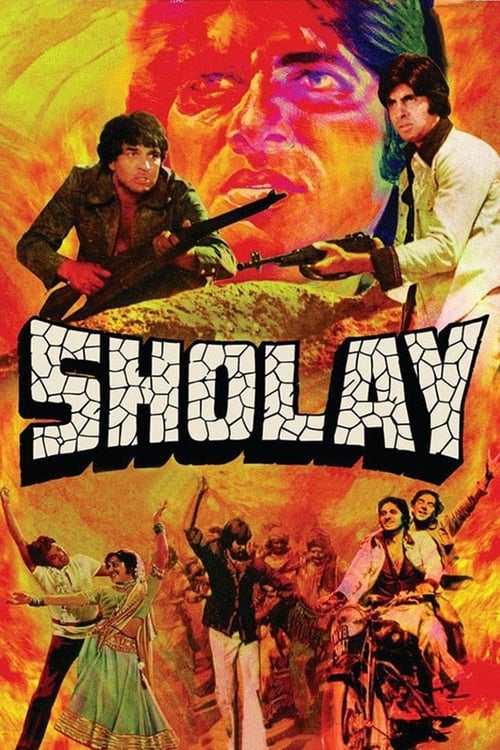
After his family is slain by notorious bandit Gabbar Singh, former Inspector Thakur Baldev Singh enlists low-level outlaws Jai and Veeru to capture Gabbar and seek revenge.
Sholay isn't screening in cinemas right now.
Follow the film in the app to get notified when showtimes are added.
Sholay showtimes, refreshed every morning
Pick your cinema, get a nudge before it leaves screens.


Sure, it's no Seven Samurai but then again Seven Samurai doesn't have a scene where Takashi Shimura plays a harmonica solo while sitting on Toshiro Mifune's shoulders as he drives a motorcycle.

for a few rupees more

Once in a lifetime, there comes along a movie in which everything is just right: a brilliant screenplay, perfect casting, a badass background score, and whistle-worthy dialogue. The result: a film that has become the single most iconic element of Indian pop culture.Most Bollywood films are around three hours in length (because they say that when the masses pay money to watch a movie, they not only want to watch a world completely unlike their own, but they also want to sit in an air-conditioned hall for a good chunk of their day). But most Bollywood films haven't actually got enough material to stretch out over so much time, making them a chore to sit through.But Sholay is not just any Bollywood movie. It's a spaghetti western with shades of Seven Samurai. It's not set in some idyllic, grassy town, but in a dusty village. And all of the major characters were already superstars, but here they are allowed to look like real people rather than the polished, good-looking archetypes they played in their other films.In Sholay, two thieving friends named Jai and Veeru arrive in a village on the request of Thakur, a wealthy landowner with a personal vendetta against Gabbar Singh, the leader of a group of bandits that regularly terrorize the village. Thakur commissions Jai and Veeru to capture Gabbar Singh and bring him back alive. The friends say they'll do it, but they want a handsome sum of money in return. Thakur agrees. And the chase begins.But that’s not all. Bumbling, happy-go-lucky Veeru falls in love with a fiesty village girl named Basanti, while the stoic and deadpan Jai harbors feelings for Radha, the young widow of Thakur's son.And then there is Gabbar Singh himself, the villain to trump all Bollywood villains. He is not evil simply for the sake of the story; he delights in being cruel, in crushing things smaller than himself. He's shifty-eyed and slippery as a snake. And he's almost definitely crazy.Sholay is epic in every sense of the word. Each character is so wonderfully fleshed out that even the cameos have become iconic. It contains enough material to sustain its lengthy running time, and I'll hear nothing against the musical numbers because that's just what Bollywood is. Our films would not be ours without songs.Of course some of the comedy appears dated and there is a fair bit of over-acting, but it helps to see the film in context. In 1975, Bollywood did not make films like these, or contain performances so restrained. In fact, it still doesn't.The main actors in Sholay were all superstars playing to type, but here they are more than just the happy romantic or the angry young man - they are integral parts of a bigger story, rather than the principle attractions in a frothy love story.Sholay provides a remarkable amount of social commentary for a big, brash commercial film. The love interests are not the pretty ornamental things they play in other films, for one. Basanti may talk incessantly, but she drives a horse-driven rickshaw, has a pulse-pounding chase sequence, and saves her man's life a couple of times.And Radha is a grieving widow, which in Indian society meant that she had to resign herself to a colorless, lonely existence. Her romance with Jai is carried out only through looks of veiled longing and a few melancholy bars of music from Jai's harmonica. But even that broke ancient cultural norms, because it was taboo to even think that a widow could marry again.All of this takes place in a village that presents the ideal India: a secular place where Hindus and Muslims live in harmony. And out in the mountains are the bandits, who perch on gigantic rocks and wait for unsuspecting villagers to wander into their domain. There is no evil inside the village, only some moments of cowardice, but the people are chastised by an old man who embodies the conscience of the town, and therefore, of India.How do you properly describe a film which feels like family? We know all the dialogues, our kids love doing Gabbar Singh imitations, and watching the film even for the first time gives us a feeling of deja-vu. Sholay is a part of every Indian, four decades after its release, and it will remain so for many decades more.How is the casting so perfect? How did Amjad Khan, a complete newbie to films, deliver such an iconic performance as Gabbar Singh? Did the legendary writer duo Salim-Javed have any idea that their dialogues would be recited decades later by my five-year old cousin? And how is it that Sholay has become nothing short of immortal?I'll be frank: I have no idea how Sholay will translate for foreign audiences. After all, it is one of those films that you need to grow up with in order to enjoy it the way Indians do. But I'll recommend it nevertheless. It's not every day you get to watch a musical western set in rural India, after all.(I wouldn't watch it on YouTube if I were you. Both the quality and the captions are abysmal.)
A former police officer hires two outlaws to help him seek justice against the ruthless bandit who destroyed his family.
Ramesh Sippy directed this 1975 production, which remains one of the most culturally significant films in Indian history.
The film received the Filmfare Award for Best Editing and maintains a position as a cornerstone of Indian popular culture.