
“I thought you was a chicken” is probably my favorite intertitle ever
We use cookies to personalize your experience and analyze traffic. You can opt out at any time.

Directed by Charlie Chaplin
An acclaimed, moving adventure.
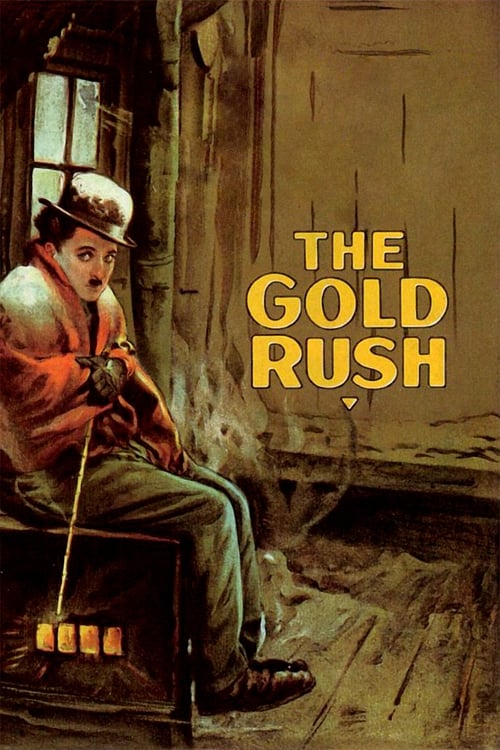
A gold prospector in Alaska struggles to survive the elements and win the heart of a dance hall girl.
No showtimes for The Gold Rush in Los Angeles today.
The Gold Rush showtimes, refreshed every morning
Pick your cinema, get a nudge before it leaves screens.


“I thought you was a chicken” is probably my favorite intertitle ever

Nothing can better portray the human condition than two hungry dudes gathered around the fire eating a boiled shoe. Herzog took notes.

After his short films, I have to admit I don't actually find Chaplin's movies all that funny. But they are consistently moving, provocative & especially heartbreaking. And if we subtract this movies brilliant coda - this is one of the most heartbreaking movies ever made. One can sense that Chaplin is not a person who understood sarcasm. The Tramp is a dot in the world, almost imperceptible, and saddest of all thinks so much better of the world than it actually is. He has no conception of the casual cruelty of other humans. He dreams, makes plans, all based on an inkling of a hope that's based on a joke anyways. And maybe it's these same kind of dreams that which people put themselves through starvation and mental torture in hopes of one day finding a mountain of gold.This is maybe Chaplin's only silent film where he asks us to observe the Tramp rather than necessarily identify with him. Although Chaplin's formal approach is quite similar to his other Tramp films, this is the only one where the Tramp is (while still clearly the protagonist) surrounded by a multitude of characters. The film opens with herds of people climbing up a mountain, this opening iris clearly intended to evoke a sense of spectacle and wonder. This moment is wonderfully economic & seemingly amateurish - shot after shot continues to try to evoke this sense. Then suddenly, a man collapses in the snow and we cut back to the shot we iris-ed out from initially. The nature of spectacle and wonder indeed. The next shot is hugely important: Chaplin's first appearance in this film, but also the mis-en-scene sets up the tone for this entire film. It's much different than the last scene, much too fantasy, too much sheen. Like watching paper mache and painted backdrop. I remember reading a review (a negative one, believe it or not!) comparing this to Chaplin's Woman of Paris, and claiming this is bland and unsophisticated compared to the former. It is neither, but what I learned through this viewing was that Chaplin's innovative work on that prior film heavily informs the work on this one. Both films treat the viewer as though they are "outside," safe from the narrative - which is a trick. In this fantasy land of snow and endless landscape this only serves to make the realities more clear - the reality of poverty, hunger, class inequality, the seeming impossibility of love between classes - in fact no director is more conscious of the universe's innate cruelty. This is not an ironic film, far from it actually, but it is a film which is the work of an intensely sincere person, struggling to deal with the ironies which exist in our daily life. In this seeming simplicity something must be said Chaplin's staging, eons more sophisticated than many critics have been willing to say. As Chaplin has said himself, he stages so that complete emphasis is placed on him as the performer. This is true, however the skill of which this is required is immense: such vast spaces are not bland as so much as they serve the purpose that the performance takes on full emphasis. Far from unsophisticated, Chaplin is breaking down cinematic technique to the most bare of essentials. Only things which need to be seen, will be seen. This reminds me of what Straub said when talking about Chaplin's films at Essanay in 1915, that he is not overthinking a cut but thinking so mechanically that the cut must come as quickly as possible - pure A-B cinema. Daney wrote that with Ford, "a shot is only on screen long enough for the eye to see what it needs to see," but to my mind this makes much more sense if it is applied to Chaplin.There are things in this movie however, which one might not even notice until multiple viewings, like Georgia's wink towards a friend while they "joke" with Charlie in the cabin. I did not notice that until this viewing, but that being said it is not in the 1942 version, and the original silent version has been in such poor quality until recently that I might not have noticed. This wink is key in that it confirms what one might have suspected - that the Tramp is that hell of two words - "too sensitive," while also heightening the complexity of this film - there is nothing wrong really with Georgia or any of her friends - maybe they just live in the moment and dreams are far from this place...who knows. There is a cruelty here, but it's sad because everyone has no conception that this even exists. Or it's sad because the Tramp is too naive, too gentlemanly, too kind. He is direct and sincere...and gets crushed for it. The Tramp is a pawn in a game that it's players are not even aware of.Again, a very simple person struggling to re-conciliate himself with a very complex world. The complexity this movie ended up having is remarkable...what other comedy seriously deals with possible repercussions of humor? It's a darkly serious movie in other regards, yes people starve, are reduced to eating candles and their own shoes, and eventually consider eating each other. Legions have written on Chaplin’s turning of starvation, hallucination and the possibility of cannibalism into something humorous, (still, few seriously ponder how dark this really is) but what always what continues to strike is is how Chaplin films food itself. Chaplin’s score becomes hugely important here as well, listen to how it lilts upon these shots. Upon the Tramp’s first entry into the cabin he drops everything he has so he can eat a chicken leg, which Chaplin then lingers on in close-up. Later look at how Chaplin lingers on the beans being poured into a bowl in Hank Curtis’s cabin. This sequence is very moving to me: “The following morning,” the title states and we see the Tramp wander by a house, without shelter, money or food. He looks into their window. Need I write on the New Years scene? I won’t, but what is just as moving to me is when Georgia and her friends accidently wander to The Tramp/Hank’s cabin. I already wrote a bit about it, but it’s so sad not just in such casualness, but because - well look at the way Georgia, Jack, all their friends act. They are so natural - some of the most “natural,” least overemphasized acting in silent films. They are ‘normal’ people. Georgia is genuinely a nice, caring person. Is the Tramp not normal? No, but maybe he is just too human. Even after they realize they broke poor Charlie’s heart the game still persists. Jack gives the Tramp a letter that Georgia intended for him (the former), which says “I love you,” at the end of it. They’re fucking with the Tramp just for the hell of it, without possibly thinking that something like this might have consequences. But why should it? Look at how the Tramp stands outside of Georgia’s door, refusing to let Jack in. He is a creature from another time, a dedicated gallant, a figure from the 19th century - but he is genuine. That it seems so strange to these people his behaviour, it is probably because such kindness and generosity had ceased to exist. One thing about the New Years scene - those close-ups of people during the Auld Lang Syne performance. It’s the only of the Tramp films where the world the Tramp lives in is clearly defined - to be a bit more blunt (and though I love all Chaplin wholeheartedly) it and Woman of Paris are the only of his films to have interest in things beyond himself.
The story follows a lonely prospector who travels to the Alaskan Klondike, where he struggles against freezing conditions, hunger, and his own quest for love.
Charlie Chaplin directed this silent film in 1925, establishing his role as a central figure in early twentieth-century cinema.
Full schedule on Mood.