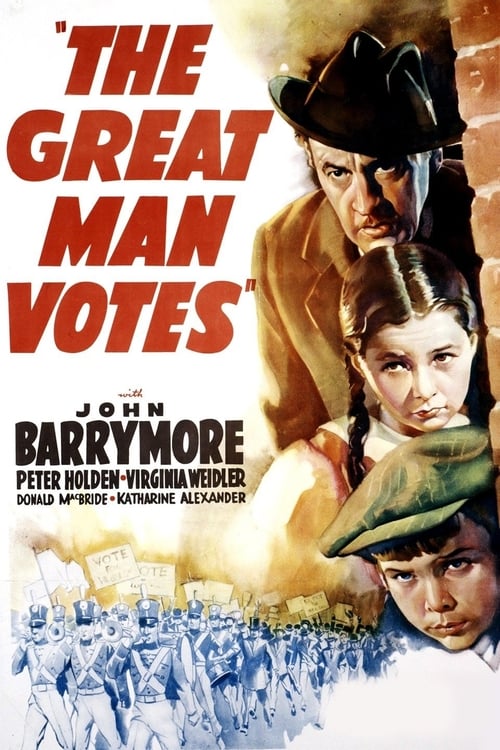
“We’ve got to save that splendid man from his bottle!”The Great Man Votes is a curious mix of Matilda, Mr Smith Goes to Washington, and - bear with me - Blackadder’s Dunny-on-the-Wold by-election. There’s no dachshund named Colin and the film is disappointingly weak on the issue of tougher sentences for geography teachers. But we do get an awful lot of child acting - Virginia Weidler shines, as always - and a very generous dose of Barrymore eccentricity and deep thirst, blurring real life and fiction. Nicely directed, it’s a weird one, but faintly enjoyable. I’m no great man, but I think it gets my vote. Just. Don’t mind me; I’m just over here obsessing about John Barrymore
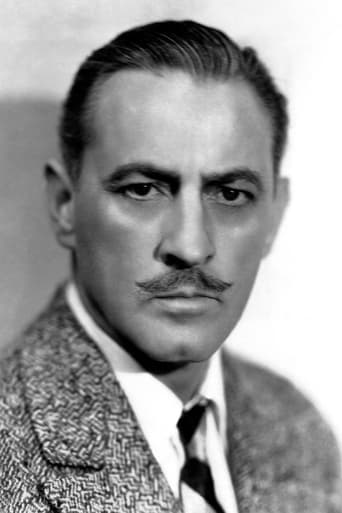
John Barrymore was the best and quite possibly the laziest actor of his generation. He reinvented Shakespeare on the American stage, with the help of astonishingly talented collaborators Ned Sheldon, Margaret Carrington and Edward Gordon Craig, before making a near-permanent transition to the screen, where he found that while occasionally there was something worthy of his gargantuan talents (The Beloved Rogue, Counsellor-at-Law), most of the time he could just throw an eyebrow and a finger skywards and that satisfied the punters and paid the bills.By the late 1930s, a string of failed marriages, a disastrous approach to his personal finances and a severe drink problem had left him in the unfortunate position of having to accept whatever work came his way. Like three Bulldog Drummond films, each worse than the last, which is fairly astonishing given how bad the first one was.Meanwhile, former wunderkind of the American stage Garson Kanin – the 24-year-old assistant who had turned around director George Abbott’s fortunes almost single-handedly – was gearing up to shoot his second film. Having served an apprenticeship as a prospective executive under legendary independent producer Sam Goldwyn, he had risked it all to start a career as a filmmaker over at RKO, where his debut – A Man to Remember – met with rave reviews and emerged as one of the major sleeper hits of the year. Given the chance to pick his next project, he alighted on a dormant project called The Great Man Votes, then somehow managed to persuade boss Pan Berman to let him cast his personal idol, John Barrymore, in the lead.When Kanin rang Barrymore to speak to him about the part, the legendary thespian asked him to come right over, and greeted him in his customary style: nude. Though it's tempting to applaud the star for a lifetime of carousing, debauchery and being a ‘ledge’ or whatever, it was frankly this kind of behaviour, reinforced by sycophantic acolytes and frequent boozing, that moved Barrymore from the realm of the immortal into the Bulldog Drummond canon. Kanin, though, knew how to handle Barrymore, insisting that his cast and crew foster an atmosphere of formality and mutual respect by calling Jack as “Mr Barrymore”, and firing anyone who brooked the idea. The result, bar the occasional tantrum at little co-star Virginia Weidler’s scene-stealing, was remarkable: an unexpected professionalism on set, and the last great lead performance of Barrymore’s career.The Great Man Votes is, to all intents and purposes, a smart but standard B-movie, a sweet little story about a down-and-out ex-teacher (Barrymore), on the skids since his wife’s death, who ekes out a living working as a night watchman, so as to support his two kids (Peter Horton and Virginia Weidler). With an election looming, he suddenly finds himself the only voter in a key precinct, and the toast of the town – working the angles to get the best deal for himself and his family.The story isn’t always exploited as keenly and clearly as it might be and the supporting cast is mediocre, but it’s a solid mix of family comedy and political satire – with a sting in the tail – and presumably a minor influence on Preston Sturges’ films of the subsequent decade, casting Sturges regular William Demarest as a shouty ward boss. Where it excels, though, is in Kanin’s inventive direction – like a simply wonderful sequence in which Horton and Weidler walk to school deep in conversation, Kanin only shooting their fleet feet – and in Barrymore’s performance.He was working from cue cards, as his memory ailed and his enthusiasm for learning dialogue waned, but he was at least energised about the project, thanks to his spirited, intelligent director, with the pointing, eyebrow-raising and eye-rolling all kept to a merciful minimum. Those tics aren’t eradicated completely – at moments he still goes for the easy gag or the lazy gesture – but this is Barrymore closer to his best than at any other time after Twentieth Century, in which he gave a simply legendary comic performance. One of the most telling things about the star is just how well he played fragility. When he was on top, he didn’t seem to know how to act, or at least how to act well, coming off as smug, broad and triumphal. But when he was vulnerable – as in A Bill for Divorcement, his staggering 1932 portrait of a man beset by crippling mental ill-health, or here, wracked with unhappiness, sodden with drink – he still had it in spades. If you want to know why, read John Kobler’s book about Barrymore, Damned in Paradise, which paints him as a mercurial lost soul, tormented by his father’s descent into madness.For Barrymore, there was to be no grand revival. After a charming supporting part in Mitchell Leisen’s classic rom-com, Midnight, he slipped into sad, self-parodical projects, as his life slipped into the abyss. The Great Man Votes, though, is something like a great, low-budget hurrah for the actor that was: a tender, touching characterisation that showed what he could still deliver when he stopped being a dick and just did his job.