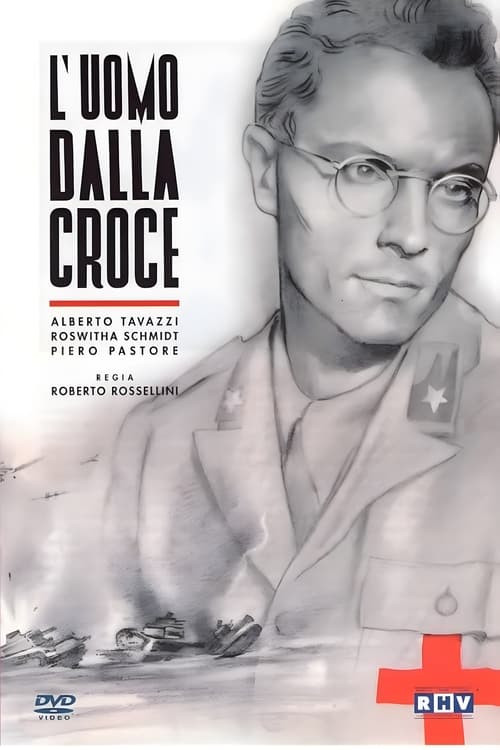
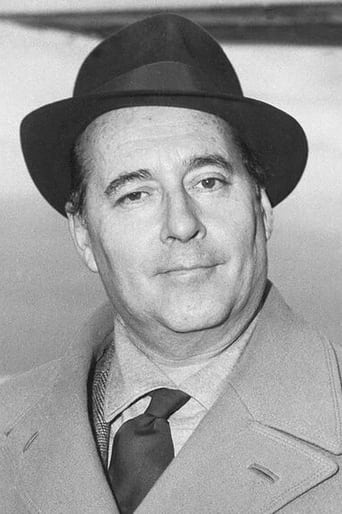


The final film in Rossellini's so-called "fascist trilogy" continues the trend of obscuring the director's confused, self-interested political values. On the side of wartime propaganda, the battle between Italians and Russians ends with an Italian victory, but this is hardly the focus of the film. Italian soldiers are again depicted as obsessed with machinery and merging themselves with Mussolini's slogan, "men and machines, a single heartbeat," similar to La nave Bianca and Un Pilota Ritorna. Perhaps the most blatant example of appeasing the fascists is its preference for fiction over documentary, which represents a break from the previous two films. You have to remember here that melodrama and Hollywood-inflected stories was precisely what Mussolini wanted, since American imported, escapist films with fictionalized storylines retained the status quo. Fellini called them "seductive films [that] showed a paradise on earth," a paradise that kept people entertained, not political. L'uomo dalla croce doesn't depict paradise (it is, after all, a war film) but it does utilize generic conventions associated with typical Hollywood war films. Peter Bondanella clarifies this point: "We must remember that Vittorio Mussolini wanted to reform Italian cinema by making it more like Hollywood to capture the imagination of heterogeneous populations all over the world."L'uomo dalla croce takes place largely within a melodramatic context, going as far to recreate authentic battle conditions in a very Hollywood style setup. Previous films in the trilogy skillfully combined documentary footage with fictional/sentimental elements, but here the only trace of the avant-garde is the use of nonprofessional actors. Bondanella says of the film that "traditional cinema clearly overshadows experimentalism." Aesthetics aside, the film's larger preoccupation centers on a commitment to Catholic morality and the virtues of self-sacrifice and selflessness. The regime upheld these values, prioritizing love of country over love of freedom, and critics have identified this as evidence of the film's fascist ideology. One problem with this interpretation is that the film's theme of brotherhood transcends all political alliances and suggests that enmity has no place in the world, suggesting further that war serves no one in the end. The Italian military chaplain demonstrates this point the best. He's glorified to the extent that his Christianity is a neutral ethical standard, one that cares for friend and foe, Italians and Russians alike, regardless of their political affiliations. While the war rages on between Russian and Italian artillery, the chaplain is serving both sides, caring for the wounded and the miserable. He even risks his life at one point to baptize a Russian child, proving that his ecumenism is larger than his politics. It's a remarkable affront to the regime. By merely showing Italians fraternizing with Russians, political alliances are eclipsed, German objectives are mocked, and fascist propaganda is confounded. Still, there's a final wrench that gets thrown in at the end that feels most likely due to censors. The closing title card, shot with deliberate focus on the dead chaplain, doesn't mince words on how to interpret his actions. If anything, "us vs. them" rhetoric seems reinforced: "Dedicated to the heroic chaplains who fell in the crusade against those without God in defense of their country and in order to bring the light of truth and justice even to the land of the barbaric enemy." Such polarizing language clearly identifies the good guys (Italians) and the bad guys (Russians), but it may also have something to do with the director's opinion of Christianity. Tag Gallagher indicates that "Rossellini considers communist ideology contrary to the moral tenets of Christianity and believes it deserves to be destroyed." This isn't proof that Rossellini was some convinced fascist ideologue. Given the film's ecumenical portrayal of Christianity, it's proof that he was deeply conflicted about any kind of political philosophy and so he uses Christian martyrdom as a way to express loving one's neighbor over our own petty, infighting existence. Bondanella states: "Rossellini requires the viewer in L'uomo dalla croce to accept his assumption that following the moral code of Catholic Christianity, a doctrine elevating self-sacrifice and love for one's neighbor over even our own existence, entails an ethical choice of heroic proportions." Bondanella then makes one more daring, not widely known or appreciated observation: "The religious commitment portrayed links this film within a trilogy on the horrors of war to Rossellini's neorealist classics as well as to the various films made during the immediate postwar period with Ingrid Bergman."Understanding the bridge between Rossellini's "fascist trilogy" (1941–43) and his grittier "neorealist trilogy" (1945–47) is key to understanding his mode of aesthetics, his blending of melodrama and realism, and the social messages of where his brand of cinema was headed. What is the relationship between prewar fascist cinema and postwar neorealist cinema? You have to watch ROME OPEN CITY and PAISAN to find out, but it's better that you first waded through his so-called "fascist trilogy" to see how the cookie crumbles.Rossellini Ranked