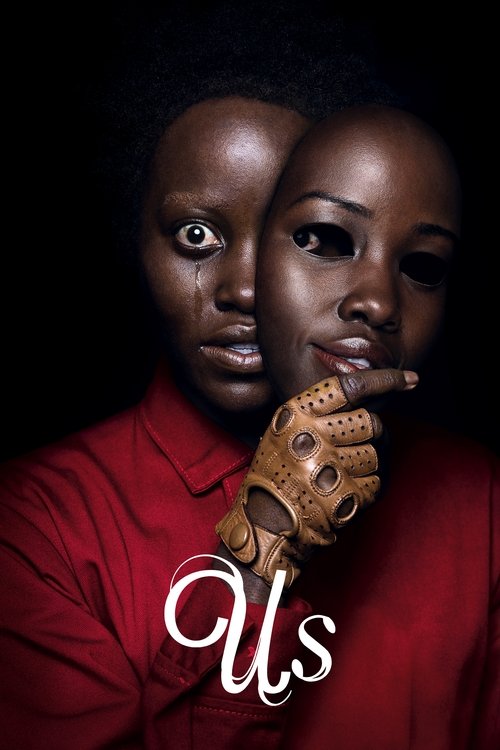
“but your people took it for granted”this is such an interesting movie in the sense that you can go as deep as you’d like to go with it. at surface level is a very thrilling and accessible horror movie, but the possibilities are endless from there in all kinds of different directions. i’ve been thinking about it more and more, and during my rewatch tonight my mind was racing with bigger picture theories the entire timethe most fascinating theory that my thoughts were preoccupied with involves the switching of the two girls at the beginning and how it shapes the story: we learn at the end that they switched as children, but the way that this information affects the story is imperative. the first time i saw it, one of my friends turned to me during the end credits and said “so the main one was the evil one the whole time” and without having to think about it i immediately said to her “no, that’s the whole point, neither of them were the evil one” this is “the grass is greener on the other side” in a literal sense. before the girls, the people on earth and the tethered below didn’t know of each other (probably, maybe). after the girls, the one above developed a survival instinct because of the hell she once knew, and a paranoia that revenge was coming for her. and the one now tethered below knows what she’s missing out on and sets a plan in motion. an uprising is possible only because she’s aware of greener grass, and the revolution begins with that knowledge. the plan she builds is based on childish ideologies because she’s been stuck down there since she was a child, she even starts her first monologue like a fairy tale. for one girl, her trauma keeps her alive and willing to fight for her better life and for her family. and for the other, her trauma manifests into anger, revenge, and reclaiming the life she once had but barely remembers. neither is evil, but neither is really good either. just like anyone, just like everyone. all we have is circumstance and how it shapes us and what we do about itit also brings sympathy to all of the tethered, most plainly in the scenes where elizabeth moss 2.0 is applying lip gloss. she smiles and laughs in the mirror, but there are tears in her eyes. has she always longed for this unattainable life, stuck in a constant mimicking of applying makeup and wishing it was real? or did she not realize how much she was missing until she saw for herself? there’s no real answers for a lot of the questions that the movie presents, but the fact that it presents them at all speaks volumes to it’s depth as a seemingly straightforward horror film. i’m thinking about these things i’ve written here, but you might be thinking about completely different aspects of it. and even if my theories are wrong, the fact that i’m thinking this far into it proves it’s worth: this is the kind of movie that begs to be discussed, and that’s why i’m truly enthralled by itsome other things: the whole sequence in josh and kitty’s house is brilliant, especially the good vibrations part. and the dance at the end? i’m getting chills just thinking about it. also this is maybe the funniest movie of the year so far? jordan proves with good writing that comedy can mix with horror without being too over the top or diminishing the fear. phenomenal. i have so much more i could say, but i’m gonna save that for my next viewing“it’s our time now. our time up there”
Themes Explained:After a second viewing and researching various theories, I’ve realized there is a lot more to Us than I initially thought. The surface-level explanation of the plot is generally straightforward, but Jordan Peele has embedded so much symbolism and thematic commentary into the film that require a bit more digging into. I have taken the ideas that stood out to me the most and compiled an interpretation that I feel is closest to what Peele was going for. I’m sure there are many other theories that work, but if anything, I hope this analysis increases your appreciation of a film that I find nothing short of genius.The main underlying theme in the film deals with income inequality, specifically in America. When Gabe asks, “Who are you people?” Red replies, “We’re Americans,” and even the title of the film is an indicator (Us / U.S.). “The film is an allegory about a nation so divided between those above and below that it feels like the only outcome is a bloody one of self-destruction.” The final battle even takes place in a classroom at some point... it’s literally a “class struggle”.Through this lens, the tethered represent the lower class: the poorest members of American society. They are quite literally below everyone else, living underground and near the sewers. They eat raw rabbit meat and have an overall poor quality of life, especially compared to those above who take what they have for granted without realizing there are others just like them who don’t have those things. In a way, the tethered demonstrate that the differences between people are superficial and based on our status and upbringing. They’re “us” without the luxury of choice many people of privilege take for granted. There was no healthcare for poor Americans in 1986 just like there wasn’t any for “Red” after her throat was crushed when her young doppelganger choked her, resulting in her speaking the way she does throughout the film. She knew how to speak but was silenced for years, along with the rest of the voiceless below.In contrast to the tethered, the Wilsons are representative of the middle class. They are a perfectly functional family unit, living comfortably and even affording some luxuries like a vacation home and a boat. However, they make envious remarks about the Tylers who have better things- a nicer house, car, and the latest technology. They represent the upper class. They live very wealthy lives, drink all day, and barely talk to one another. This idea of being a member of the middle class looking up is even foreshadowed early on when young Adelaide’s dad is winning her a prize. The man at the booth tells them they can currently walk away with a prize from the second level… or keep playing for a chance to win a prize from the highest level.Peele’s main focus in this exploration of social class is centered on Adelaide. She is someone who rose up from the lower class (through wrongful means) and now fights tooth and nail to protect her new status. She seized her opportunity and ran with it, pretending that the generations of struggle she came from didn’t exist and that as long as she looked the other way, she didn’t have to return to it. Red was left behind to rot and lost her status, so she attempts to reclaim it by starting a revolution since she is the only one below who is aware of the life she is missing out on. This dynamic gives added meaning to the moment when Red tells Adelaide that they could have escaped together all those years ago instead of Adelaide leaving her behind. Red essentially tells Adelaide that she didn’t have to drag her down to pull herself up. Adelaide is aware of this and shows survivor’s guilt when she sympathizes with the tethered children as they die. She takes pity and sees herself in them since they were just trying to do the same thing she had managed to accomplish.A noteworthy detail in the film is that the escalator connecting the surface world to the underground only goes down. Many times in society we hear how the rich get richer and the poor get poorer and that it’s systematic. This is symbolized by an escalator that is built to always go down, never lifting people up and forcing them to stay in their undesirable situations.There is a great deal of moral ambiguity to the film and it’s difficult to ascertain which side is good and which is evil. It’s just as difficult in real life, so much so that we often decide to do what Jason does in the end: put his mask back on and just go with the flow. However, that may just perpetuate the cycle of choosing not to truly evaluate who we are, both as individuals and as a society, and thus turn a blind eye to the problem until it becomes undeniable as it does in the film. Us serves as a warning about what happens when income inequality becomes so great that the only way to get attention is to make a statement… one that may not be channeled through peaceful means. In her desperation, Red and her tethered comrades resorted to violent measures to get out of their situation, just as young Adelaide did back in 1986. To Red it seemed like the only way out, and despite her death, she did manage to lead her people out of the bunkers. This seems like an appropriate time to provide the definition for the word “redlining” - the systematic denial of various services to residents of specific, often racially associated, neighborhoods or communities. In the final shot, the tethered are holding hands and dressed in red jumpsuits, literally forming a “red line” across America as a statement that communicates their circumstance.There are a few recurring aspects of the film that I wanted to touch on briefly, one of them being the appearance of 11:11. In the Bible, the verse translates to something like “I will bring on them a disaster they cannot escape. Although they cry out to me, I will not listen to them.“ This works both ways in the film: it is true of the people living above who have condemned those below to an inescapable circumstance without paying them any mind, and it works as a motto for Red’s uprising, speaking of what they will do to those above. 11:11 itself is also the only time that is perfectly symmetrical. Other recurring items are the scissors. These can be thought of as objects consisting of two identical sides whose purpose are to cut or divide.I’m not entirely sure what the rabbits mean, but I think they might represent the tethered. Them being locked in cages in a classroom underground during the title sequence could represent how they were literally trapped in the “lower class”, and when the doppelgangers have all escaped their prisons by the end, the rabbits have also escaped from their cages. Red even cuts off the head of a stuffed white rabbit, perhaps as foreshadowing for what she was going to do to Adelaide, who was also one of the tethered.Now, there is also another theory regarding an additional twist in the movie, and it is actually backed by some pretty solid evidence: Adelaide wasn’t the only Wilson who was a tethered… Jason was as well. Hear me out!It seems that Jason was swapped out with his tethered during last year’s trip to the vacation home. The family makes multiple remarks about last year: When Jason is asked about his magic trick, he said he left it there last year, but he doesn’t know how to make it work anymore. Also, when he gets locked in the closet, his sister comments “Didn’t this happen last year?” He seems to have forgotten a lot in the past year, and when the doppelgangers come to the driveway and his dad asks Jason to get the bat, he remarks “What bat?” while his sister immediately knows where it is. The most striking detail comes when Adelaide is trying to get him to snap on rhythm. He has a hard time doing so, and Adelaide isn’t in rhythm either, hinting that they are both tethered. This comes into play later on when Pluto is holding the match and is snapping perfectly in rhythm. It’s as if he’s letting Adelaide know that it’s actually him and he smiles at Jason as if to say, “She knows I’m her real son.” Then when he dies in front of her, Adelaide yells out “No!” and reaches out, shedding tears for the death of the son she’s been raising all this time, excluding the past year. He couldn’t speak because of the burns on his face, and considering Adelaide was silenced by her doppelganger who crushed her throat when they switched places, the real Jason was likely silenced by his tethered counterpart when they switched. He probably tried to do the same magic trick last year, and while it didn’t work for him on the surface, the real Jason was underground playing with a match instead of a lighter and burned his mouth, searing it shut.A major question that this theory begs is how Jason was able to speak well enough so quickly that he didn’t raise serious suspicion from his family. The most reasonable explanation is that Red had been planning this uprising for years and switching out Jason was all part of the plan. Therefore she likely taught him English underground from a young age to prepare him for the surface. The family still must have noticed some minor changes though, but in the scene where Gabe is trying to convince Adelaide to go to the beach, he mentions how Jason was really looking forward to it- his grandma died last year, and he didn’t take it very well. Any strange behavior was probably thought to have resulted from the trauma of his grandmother’s death.I know there are still some things that don’t add up, primarily how they were able to switch if this was their first family visit to Santa Cruz beach. But still, this all can’t just be a coincidence. There are a number of other signs in the film as well:-Jason, like Adelaide, doesn’t talk much and is much closer to her than his dad or sister-His family comments in the car that he has been using strange new vocabulary-The girls at the beach make fun of him because he’s building a sand ... tunnel-Like his mother who was eating strawberries, he was the only other family member who wasn’t eating fish, perhaps because he was also tired of eating meat as a tethered-Adelaide and Jason are the only two whose doppelgangers aren’t trying to kill them. Red did towards the end but hers was calculated and prolonged. Pluto just wanted to play with Jason-Pluto tries to communicate with Jason in the closet. Pluto and Red are the only doppelgangers who attempt to communicate with a surface dweller-When the twins first attack, they only attack the sister… they know Jason is a tethered-The name Pluto might also be a bit of a giveaway. Pluto was widely considered to be just another planet until recent years, just like the real Jason who was just a regular kid until a year ago when he was swapped out and shunned by society.If this theory is correct, then it totally changes the context of the intense stare he shares with his mother in the car at the end. Jason isn’t wondering if Adelaide is a tethered, he’s wondering if she knows that he’s one as well.-I wrote a similar review for Nope if interested.--Major credits to JJoker1117 from Reddit and David Crow from Den of Geek