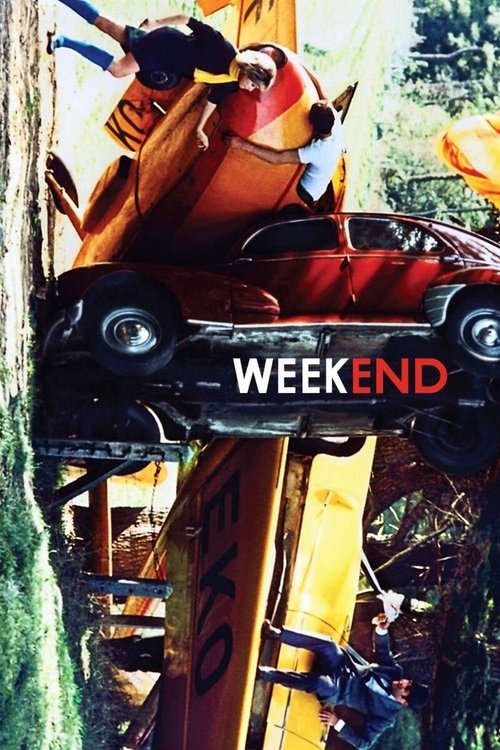
72/100For about an hour, Godard's greatest film, achieving a perfect balance between playful dialectics and formal bravado. Even the epigrams don't annoy me as much as usual, perhaps because they so annoy the protagonists (who just keep doggedly asking which way Oinville is, shouting louder and louder over the quotations). In the home stretch, however, watching it starts to resemble what I imagine it was like to see Andy Kaufman stand onstage reading The Great Gatsby aloud—admirable in principle, but tedious to actually endure for any length of time. There's a big difference between the astonishing traffic-jam sequence-shot, with its constant visual dynamism, and (to cite just one late example) an Algerian dude eating a sandwich for several minutes while a black dude spouts revolutionary talking points, and then vice versa. The disjunction is merely clever; it exhausts itself very quickly. Also, the film's apocalyptic background action retroactively loses some of its black-comic edge when things turn overtly grotesque/nightmarish, which is a drawback I'd like to think Roy Andersson noted and chose to avoid in Songs From the Second Floor (though admittedly he's not the aggressive political gadfly Godard is). When it's just two murderous bourgeois cretins obliviously traversing a country in ruins, on the other hand, Week End (or should it be End Week?) rivals Wavelength for grimly hilarious singularity of purpose.
The film where Godard expresses possibly his most vehement hatred of humanity I've seen and posits that the behavior of the bourgeois are empty, selfish, meaningless gestures that must be smashed but admits there is no good solution to replace the chaos in its void.Weekend follows a wealthy couple in a loveless relationship who cheat on each other and wish to murder the other; they also wish to acquire the inheritance of the woman's father and have no qualms about killing him if necessary. The audience is immediately compelled to feel disgust with the leads and feel nothing but contempt for their narcissistic nature.On the way they encounter a traffic jam, and here is where we get someplace interesting: it is a row of cars in a one-lane road that are stuck behind each other, yet no car opts to use the opposite lane to progress. This does not stop our couple, and they drive where they shouldn't to cut across all else until this seemingly-endless jam reaches its origin: a car crash, with bodies strewn around. For the audience, the annoyance felt at being mildly inconvenienced then shifts to horror at seeing the cause of inconvenience, a reminder that we must be considerate, that selfish behavior leads to loss of empathy. Not to our couple though, they continue moving forward without a thought.So, bourgeois people who are stuck someplace and willing to break social bounds can climb on top of the others to grab what they want, the death of fellow humans be damned. From here on out the film becomes more surreal and didactic, our couple wandering through a landscape that probes them (and us) of how colonialism exploits while encouraging its benefactors to look away. Eventually they meet a band of leftists who survive by cannibalizing each other and those they come across, a message that may as well be rhinoplasty for how on-the-nose it is."The horror of the bourgeoisie can only be overcome with more horror."Though marginally more likable than the couple we've been following, it is clear that their approach is unsustainable as well, a 'hippie'-like convent of Europeans that borrow ideas from Red states, but still too ingrained in their current state to carry those ideas to fruition. In the end perhaps we're closer to liberation from bourgeois politics, but no closer to being free from class struggles.