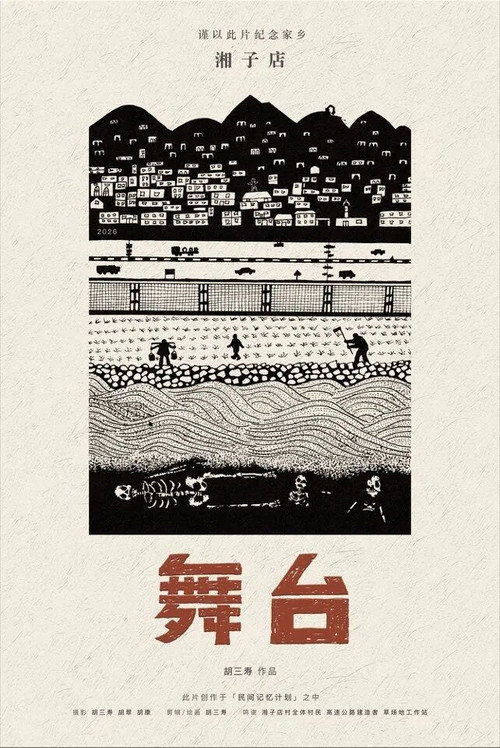

After we watched Resurrection at TIDF in 2024, my friend Christopher posted a review calling its style "artless" (which he did not necessarily mean as an insult). I do not think he would be able to say that about this film, which is gorgeous. In meticulously framed shots, Hu Sanshou captures the crisp air of his mountain village. A highway is being constructed through the village. In order to build it, graves and homes are demolished. The soil is heaped up and compacted. This process repeats, over and over, so that a platform, a foundation, for the highway can be built. This is the titular stage.Over the 150 minutes of Xiangzidian Village: The Stage, this is all that happens: the slow compaction of earth over years, its hardening, the crushing of rock, the pressing down of myriad layers of gravel and soil. The creation of a finished grade, the eventual setting of concrete forms, and the surfacing of the road. It's like a gigantic piece of land art, like something by Michael Heizer. How many other films can claim to convey with such force the heaviness of time weighing down on the land? The "stage" becomes a liminal space in between history and oblivion, the setting for a vast Beckettian play that occurs throughout the seasons, in plain air. Children play and run on it, excavators and steamrollers traverse it, elders walk across it, people take advantage of its wide-open expanse for driving lessons, doing donuts where people will someday have to drive only in a straight line. And Hu uses it as a place to set up his tripod and film all these happenings.Unlike in Resurrection, where the villagers themselves are interviewed about their lives and memories, in this film, Hu tells other people's stories for them, often while observing them with the camera at a far distance. The film is set up as a series of vignettes, with individual stories lasting a few minutes, strung together in a steady stream of narration. So there's probably several dozen small stories interspersed throughout the film, about Hu's family and about the village. The effect is that of someone gathering around a fire and telling story after story until you fall asleep, and I did doze off in the middle. But that really didn't lower my estimation of the film. Have you ever traveled away from a place where you lived a long time, and went out into the world, and returned to see a construction site transformed into a building, as if you blinked and it appeared? That's what nodding off in the middle of this film felt like.Near the end of the film, we learn that a temple, associated with the name of the village, now faces the highway. The highway, posits a feng shui expert, is now the "altar" for the gods in the temple. And Hu begins to think: what if everyone and everything streaming by on the highway are now sacrifices, offerings to the gods? He reads a news story about a section of the highway that collapsed, killing 50+ people. Later, Hu's father dies and Hu returns to the village for the funeral. Driving on the highway, he thinks that the hearse carrying his father must have already driven down the same stretches of road in front of him. The dead and the living haunt each other, pass each other unknowingly, behind tinted windows. Their spirits mingle above and below the highway, in a cosmology forever altered by capitalism and the pursuit of "progress."I saw this my first day of movie-watching at TIDF and I'm thrilled to already have found a masterpiece.