

“The Elements of an Ozu Film”19%:People walking in-and-out of rooms.37%: People struggling with the modernization of Japan—esp. how it relates to the family unit. 44%: People apologizing for the way they acted when they got drunk the previous night.
Directed by Yasujirō Ozu
秋刀魚の味
A critically acclaimed, atmospheric drama.
Widower Shuhei Hirayama's caretaker is his 24-year-old daughter, Michiko. Gradually, he comes to realize that Michiko should not be obliged to look after him for the rest of his life, so he arranges a marriage for her.
An Autumn Afternoon is showing in 1 cinema in New York City - next screening Sunday 25 October at 13:10 at Metrograph.
Next screenings: Sunday 25 October.
Full schedule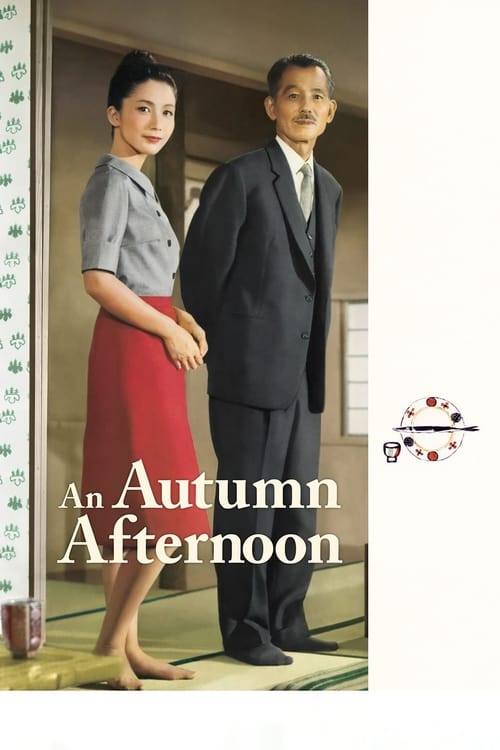
An Autumn Afternoon showtimes, refreshed every morning
Pick your cinema, get a nudge before it leaves screens.
“The Elements of an Ozu Film”19%:People walking in-and-out of rooms.37%: People struggling with the modernization of Japan—esp. how it relates to the family unit. 44%: People apologizing for the way they acted when they got drunk the previous night.

Poem written by Yasujirō Ozu on the death of his mother in 1962:Down in the valley it is already springClouds of cherry blossoms;But here, the sluggish eye, the taste of mackerel -The blossoms are melancholyAnd the flavor of sake becomes bitter.Note: 'the taste of mackerel' translates as 'sanma no aji', the Japanese title of An Autumn Afternoon

I want to say this was too direct, too straight forward a film for me, but despite this inclination, it still left me devastated. This film is about the fear of loneliness, faced boldly, and loneliness itself, warmly embraced. It's about sacrifice, and it is about being at peace with the past--or not. It is a film that lingers on every scene, letting it sink in, and a film that hints at deeper cultural ideas that I can't fathom--not being a child of World War II, not being Japanese--but that resonate clearly through the film in direct (the scenes with the marching song, for instance) and indirect (how the war has shaped each of the characters) ways. I felt the hot pressure of tears building up behind my eyes repeatedly--and again now as I write this--through this film, as Ozu's characters and camera capture so much of the melancholy parts of life. It's not just the senescent mindset that pervades certain scenes, but also the quiet futility implied by so much of the film. It goes unsaid that even though Hirayama finds a husband for Michiko that even she will one day be alone, as the Gourd suggests. All of these lonely old men were once (or still are) married; it does no good. Death takes away those we love, one by one, and we are left alone in the end. And yet, the film subtly suggests that while these men might feel alone, while we all might face death with heavy, lonely hearts, there is a certain amount of connection there none-the-less. Every action Hirayama takes is done out of love in one way or another, and he still is surrounded by people who support him and care for him. He and his old school buddies still meet up and enjoy each other's company. He runs into an old navy subordinate who treats him to a good time. He has made friends with a bartender. He still has his youngest son, who is clearly taking over for Michiko in the end as he talks about making breakfast the next day. He and his old school buddies band together to bring the Gourd some money. He may have sacrificed something to marry off Michiko, but he did so for her sake. He gives his eldest son a hefty sum of money, and he genuinely seems to care for his employees. He's a decent human being, and even if his life is a little lonelier, anyone watching can see how much he really has.I don't know if Ozu intended this film to be so bleak as to suggest that we all die alone, but if he did, there's a deep irony to the way he depicted it. I trust that he intended the final line to convey that irony--his son has just nagged him, after all, and he is singing old songs about the war, reminding us of the connections he has. My earnest hope is that Ozu intended this as a graceful acknowledgement to a life full of loved ones and friendships. I know relatively little of him, but what I have read suggests he might have been a lonely person in general. I hope not. No one who created such beautiful art deserves that.
An aging widower realizes his adult daughter has dedicated her life to caring for him, prompting him to arrange a marriage for her and confront his impending loneliness.
It was directed by Japanese master filmmaker Yasujirō Ozu in 1962, serving as his final cinematic work.
Yes, the original Japanese-language film is available with English subtitles.