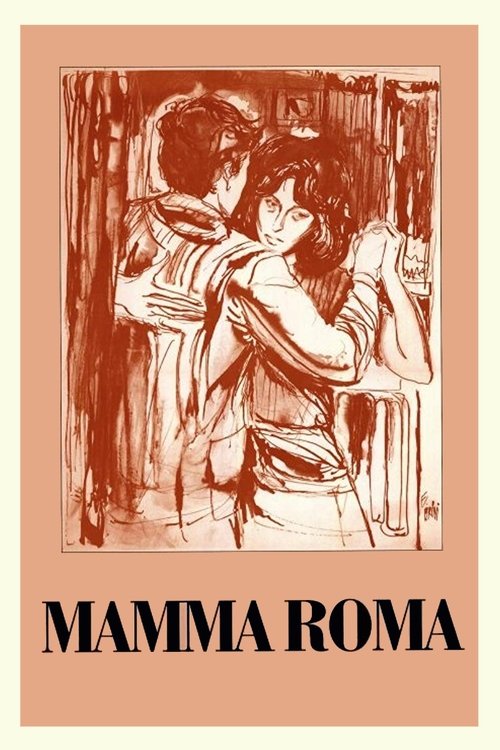
The fantasy of the the Italian night intersects with the reality of the postwar rubble in Pier Paolo Pasolini’s “Mamma Roma.” Early in his career, Pasolini still works very much within the neorealist structure for “Mamma,” the story of a single mother and her teenage son struggling to survive and understand one another on the outskirts of Rome. Although, there are, already, emergences of the director’s perception on how the forces of power manipulate the sacred body for the profane. “Mamma” stars Italian cinema icon Anna Magnani, and was banned on its initial release. Magnani’s title character walks the streets in the evening in order to support herself and her son. Mamma Roma is forced to subjugate herself sexually in order to maintain a bourgeoisie lifestyle that verges closer to the subproletariat. What begins as a tender coming of age tale of the relationship between mother and son gradually distorts into both of them losing their liberty and their identity for the illusion of consumerism. Where Pasolini starts the film in a grounded neorealism, by its concluding act, the director has mounted the woes of his characters into a nightmarish distortion. The interweaving of the familiar and the horrific distinguishes Pasolini, in only his second feature film, as an artist that is utterly unafraid of depicting the consequences of desire, and how open the possession of wanting leaves those with it to all forms of manipulation.
Feels like the only logical progression from Accattone that Pasolini could have made, trading the aimless drift of the street for a desperate, upward climb. He has this startling cinematic language at play, one that finds the sacred within the profane by framing the Roman sub-proletariat with the reverence of a Renaissance painting. It is a work of immense, dusty beauty, because he captures a specific Roman periphery. Those jagged, unfinished edges of the city, that feels like a wasteland of broken dreams. And it’s also where Pasolini finds a perfect hook; as Anna Magnani’s titular Mamma Roma is a woman caught in the exhausting performance of reinvention, trying to laugh away a past that refuses to stay buried.One can’t ignore the fact that Pasolini is observing a world where the crushing weight of class is so standardized. It’s a byproduct of an unyielding social hierarchy, but for Mamma Roma, you can't help but feel her frantic pulse as she attempts to ascend from the "life" of the streets into the respectability of the petty bourgeoisie. It’s where Pasolini finds his most piercing moments, utilizing a brilliant mix of non-professional faces alongside the volcanic, professional star power of Magnani, because you’re seeing that her every effort to provide a "better" life for her son, Ettore, is a direct challenge to a system designed to keep them down. And yet, she’s ultimately thwarted by those very forces, even as she secures her fruit stall and her new apartment, you still sense that the high cost of dreaming in this world is a debt that can never be fully paid.