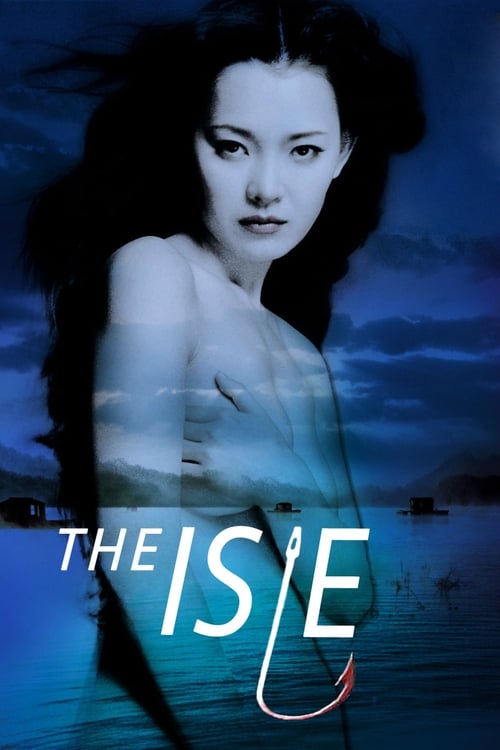







“Theme and idea are the most important facts of film production, I think.” – Director Kim Ki-DukThis is a longer review than usual and it is full of SPOILERS from start to finish. I decided to include everything because not only am I analyzing The Isle I feel I am analyzing the most provocative themes and ideas of Kim Ki-Duk's best films at large; the review touches on the metaphors of his other works. I hadn't seen the film in years. I still think it's great but am sure now it is an ACQUIRED TASTE! It's the right film for you only if you love abstract symbolism and have a desire to be weirded out. It's a chilly allegorical fable, one you need ice in your veins to get through (even if it's only 91 minutes). I am mesmerized by it in an icy detached way. The Isle is a lake village where men everywhere, a majority of them successful businessmen, travel to in order to get away from their city lives. Hee-Jin (Jung Suh) is the business operator who takes her customers on a motorboat to each of their own individual rafts that occupies a hut to sleep in. She delivers food, supplies, and often sex to them by convoying prostitutes or servicing them herself. Each man can stay there indefinitely, many of them perhaps weeks at a time.One of the male customers, via a cell phone conversation, reveals that he has a wife and child back home. Yet for him, and every other male customer, this escape allows him to fish, and to cavort with prostitutes as his preferred leisure. You become aware soon enough that this scenario is improbable and that this fishing and sex operation would hardly unlikely be found anywhere on this planet, and you start thinking on the wavelength of parable. Hyun-Shik (Yoo-Suk Kim) is the only one in the village not there for leisure and enjoyment, he is a patron escaping something from his recent past. In a flashback, he recalls his wife and her lover in a tryst. The carnal activity is followed by a jump cut that reveals their corpses. Is Hyun responsible for their deaths? The incident might explain why he is at the lake village with a gun with an intent of suicide as his form of penance. Hee-jin is clearly, by men’s standards, a beautiful woman with long hair, curves and carnal mouth (and to each raft she swims like a serpent!) Her looks beckon attention, but her frowning and grimace are unattractive – as a viewer we have to judge her as certifiably damaged. Hee-jin isn’t as beautiful as she could be, as prototypical for a Kim Ki-Duk film, she is one of his silent damaged people. Often in Ki-Duk films, a character has been so betrayed somehow in the past that they have lost the will to speak. Nothing lightens her up until she has a moment brought on by a kind gesture, from Hyun-Shik who is different from all the other male consumers. Briefly, in an unguarded smile, we see the woman for a moment in fleeting joy.But a tug of war still occurs between our two characters, each one of them taking turns being vulnerable in their situation: the man self-loathing because he is consumed by remorse by a recent violent act, the woman self-loathing because she is sick with shame of her forced lifestyle. Although consensual kindness happens between them, some jealousy nevertheless prevails. Hyun hires a young tart for a quickie not because he intends to follow through but to anger and make Hee-jin jealous who has to escort the girl by motorboat to the hut.How strange that a movie that contains no realistic grounds becomes illuminating as to the truths of human behavior and the extremes we go to possess other people. The film is full of the motif of fish being reeled in which thematically counterparts with men and women ensnaring each other for sex and companionship. Ki-Duk also serves the message that a man and woman will hurt themselves in order to get attention and clutch a tighter attachment on each other. By some point, the sight of people mistreating animals becomes equated with people mistreating people. (Critics put Ki-Duk through the wringer in regards to how fish were treated, but he assured his detractors that his crew feasted on whatever remains were left after filming.) Hyun, and the other men on the lake as well, use fishing as a way to act out on their frustrations. Significantly, Ki-Duk makes the message of frustration manifest by allowing Hyun to pound out his frustration – he hacks away on dead fish. Is it true perhaps that any given woman is willing to stay with a man who behaves violently after she's been intrigued by him, even a man who hacks and chops up fish with cruelty? Would it be the same though the other way around? Contrast must be made with Hee-jin's treatment of the fish which violates any sense of human morality, as she in attempt to act out on her frustrations, she chooses to electrocute the fish. This is not only inhuman but an act of insanity.True, Hyun never sees Hee-jin punish the fish with cruelty but he knows enough that she is crazy. But a woman, no matter how crazy, can be sexy enough or just use sex to reel a man in. A man, even with greater sense and enhanced sense of morality and justice, can see that a woman like Hee-jin is crazy. She not only hurts fish but is willing to mutilate herself. When Hyun is on the verge of leaving the village permanently, Hee-jin commits an act that, in an interpretation says I will hurt myself if you don’t have sex with me, and love me. Hee-jin is willing to give up on sex entirely, even if her vocation requires it, if she can no longer have Hyun. Her methods are not realistic, but the film is able to say something on the extremes of sexual possession.The audacious final symbolic shot suggests that Hee-jin gets her way, that Hyun has been devoured by her (damaged) female aura and will be forever lost in her essence.