
where has this been all my life
Arrested for an unnamed crime, Josef K. is trapped in a surreal bureaucratic maze where justice is unknowable and guilt is assumed.
The Trial is showing in 1 cinema in Amsterdam - next screening Wednesday 14 October at 21:00 at Filmtheater Kriterion.
Next screenings: Wednesday 14 October.
Full schedule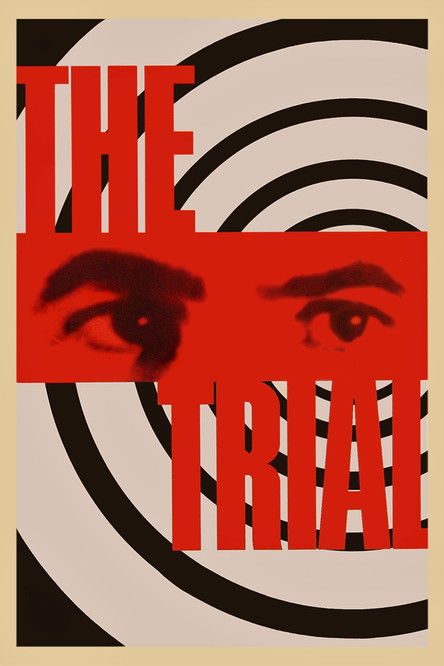
The Trial showtimes, refreshed every morning
Pick your cinema, get a nudge before it leaves screens.


where has this been all my life

Absurd. Surreal. Oppressive. All fine words to describe Orson Welles' The Trial, but I think the term that best describes how I felt while watching is 'hysterical': not in the sense that The Trial is a comedy - to describe it as a black comedy stretches the very definition to the breaking point - but that I found myself laughing to ward off the physical and mental unease it forced upon me (especially during the absolutely insane last 20 minutes). That a film can cause laughter as a defense mechanism is a testament to Welles, Kafka, and Perkins.The dialogue flies by so fast that you become inured to the fact that the words spoken are so bizarre, the sentences so strangely close to making sense, that we are dragged, kicking and screaming, into this terrifying (and terrifyingly close to our own) world that seems to be a missing link between the one we live in and that of '1984.' The story bristles with surrealism, and underneath bubbles an insanity barely kept in check.Anthony Perkins puts on a performance for the ages. Youthful, animated, he talks virtually non-stop and punctuates every word with hands that flap and flop as if his character, Josef K., realizes the absurdity he's found himself in and just wants to fly away before he reaches the inevitable end of the tale. Greatest of all, Perkins walks the line of melding the constant professions of innocence with a subtle tone of subconscious, nebulous guilt.Finally, Welles' mastery of kinetic camera movement, unsettling angles, and use of audio to create depth are instantly apparent. I was surprised (and embarrassed) to learn that The Trial was my first experience with his direction - the influence he has had on the art is so apparent that it cannot be overstated. The Trial might not be his most renowned film, but even if this had been his only effort, I feel it would have been more of a legacy than most directors could dream of.

This film stressed me on an absurd level, I felt physically ill after finishing
Arrested for an unnamed crime, Josef K. navigates a surreal bureaucratic labyrinth where guilt is presumed and justice remains entirely out of reach.
The film was directed by Orson Welles in 1962, marking one of his most visually audacious cinematic adaptations.