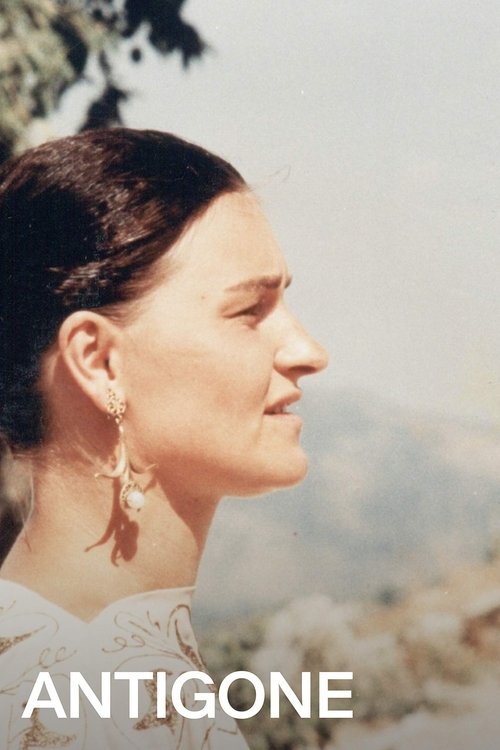


I really can't get enough of this movie lately. Already by the opening credits the senses are abstracted by an interpolation of Wagner, undercutting rousing sounds with experimental, Eisler-esque ones - alerting us right away that one cannot understand this as merely notional, in fact this is rather classical in its sensuality, perhaps more than any film of the Straubs. Returning to Brecht via an interpolation of Holderlin after 5+ years of Holderlin adaptations, this both retains the serene poeticism of the last two films while returning to the aggressive politics of the films of 1982 and prior. This results in a film which does not just combine a gestural classicism with politics via Brechtian theatre, it achieves an almost perfect balance.One can surmise (to an extent!) that in this movies design we chart an arc of the political theatrics which take place behind the eventual collapse of a civilization. But this is not a period piece - it may take place out of time, sometime in the past, today, or in the future - like Aquarium and the Nation, a key line to this film is "When we forget the past, the past returns." So then the purpose of this arc is not really to chart a specific arc, but the arc of an ongoing cycle. In the 1940's Brecht adaptation we opened with a prologue which resets the setting to 'contemporary' WW2, before entering a re-written text. This (seemingly) retains the setting of the Holderlin original and removes the Brecht prologue, but retains the Brecht text. This act (a very Brechtian one at that!) has the effect of re-purposing BB's language, written in critique of fascism to instead critique Holderlin's original subject, democracy. It does not take an expert to realize that democracy has changed very little since ancient Greece, and so the film covers both the end of a democratic system (of course, to be quickly followed by another one) as well as its inner workings, mistakes and falsities. "You who cry for unity live for conflict!" cries Antigone as she chastises Kreon. Again, this system sustains itself by repeating itself, so the film is of today, yesterday and tommorow - this made explicit in the shot revealing a highway behind the Teatro de Segesta and the sounds of helicopters upon the films ending. Delving into the movies politics is a very difficult task - this is a film that is immaculately concentrated! So every bit of dialogue flows over you yet is so absoutely necessary, as is every gesture, every place a character is positioned within a composition, every bit of mis-en-scene, every object. This film, perhaps more than any S-H (and quite honestly, maybe any film!) henceforth manages then to achieve a complete totality of form where causes and effects are equally comprehended and emotionalized. Perhaps it is key to note that Teatro de Segesta specifically existed in Greek Antiquity - however its filming there does not necessarily transpose us to Greek Antiquity as much as it frames people in it today (1992). So as we look at these old stones collapsed onto each other, all this rubble, we come to realize that these events have both come to pass and are continuing as we speak at once - this rubble both aestheticizes and indicts the system itself as one which itself is antiquated. In Brecht's version, Kreon was dressed as Nazi-esque dictator, but removed from that costume and into one from Greek Antiquity these words end up sounding both eternal and contemporary. All the world is a stage, or is it just politics? Council is also chorus, yet this chorus is equally unaware of the repetition of mistakes of council. Meantime, wind charges Antigone's body during her trial, as she defends herself as though a part of nature. She accepts death - but not as giving up, she consciously chooses to die as an act of resistance. Like this comparison with nature, Antigone is already thinking of and believing in other worlds, in close-ups she is framed by either a blue sky or wind blowing through the trees, as opposed to Kreon and council's stone hedges. And these hedges eventually take on a stunning onerism - here are people who believe in the state and divine glory, while Antigone decides herself outside of this 'world.' There are repeated shots of a set of stone tile on the Teatro, each returning cut with the camera on a slightly higher level. This tile itself is little more than a line, but the line itself is an invisible wall, this invisible wall which the characters then and ourselves today cannot see - this line is the structure, the system which preservers because we cannot remember it. Just before her death, Antigone stands before it, but she does not cross it. She has come to the new consciousness, the awareness of the aquarium. Of course later it's the blind man who perceives the aquarium and challenges Kreon with it - he cannot see so why trust his eyes? Yet why trust eyes when no one else can see either? For me this film is the true definition of spectacle, both in it's hyper-Brechtian sensibility of literately living inside spectacle yet somehow succeeding in full emotional idenfitication with its characters, probably more than any other film of the Straubs! Upon Kreon learning of the death of his son the film explodes with truly shattering emotional power - even though we should (and probably do) despise Kreon, is it possible to not feel pity on him when he raises his arms to the sky, finally comprehending the death of his son because of his folly? The totality of form forces itself upfront, every camera set-up we have seen before yet every cut comes as a shock - Kreon mourns his son, and suddenly we cut back to the council, staring and saying nothing - and we understand that they are now realizing that the entire civilization is in grave danger. "Do not mourn for me, mourn for the living," said Antigone. No shit!We return to the line and there is now a dead soldier lying on it, we return to the council and the stage feels more an enclosure than ever - Kreon tries to force his inherent theatricality, but now it can only be perceived as not just falsity but sheer self-delusion & perhaps psychosis. Not long earlier we saw the highway be revealed in the background - the future is not now, the past is, and the broken stone and crumbling bricks in the foreground with the highway of the background again confirm that this is a process which has not yet been eliminated. (This melding of contemporary/historical setting is really a more streamlined version of what S-H did in Othon) In the last shot, there are hills but no highway, bricks but none crumbling. This positioning of the camera (the decisive point, as DH put it) mimics that of those council behind the line of tile, facing Antigone. The bricks are the line, the fence, the end of the aquarium. Who knows what lies beyond this line, other than an entire world.And then there are the helicopters.