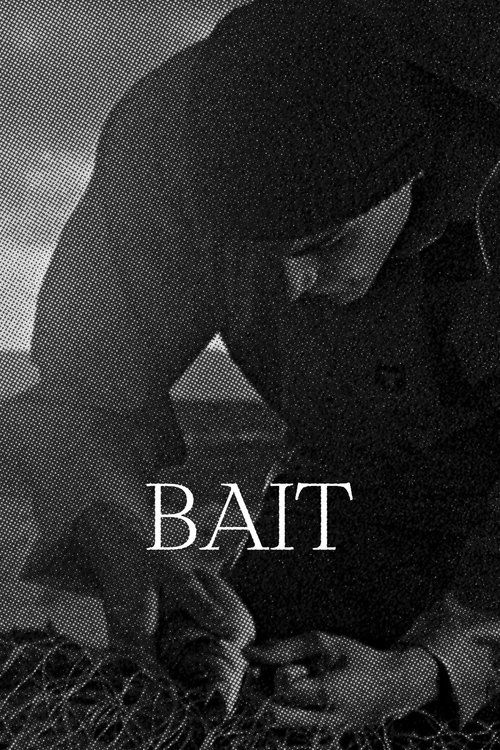


I'm not sure what I was expecting - neo-realism or retro-styled kitchen sink drama perhaps - but Mark Jenkin's entrancing film is a labour of love that borders on anti-realism with its expressionistic editing, montage and post-synced sound. It's a defiantly experimental, subtly confrontational piece that stays true to his own Dogme-like Silent Landscape Dancing Grain 13 manifesto. It looks like a long lost artefact, rescued from oblivion, but has an unmistakably modern sensibility.The way the sound is entirely dubbed in post gives the film a mesmerizing, hypnotic sense of unreality, as if the voices aren't fully anchored to the actors but hover close to them, like ghostly signifiers. It also allows Jenkin to take the ambient sound right down in the mix, privileging certain noises like Martin's footsteps and imbuing them with an unnatural resonance that draws out the elemental, almost mythical nature of his character. It's a very quiet film; what music there is is diagetic and heard at a muffled distance.The treatment of the moving image is equally idiosyncratic - entirely shot in black and white on a 16mm hand crank and painstakingly assembled in the cutting room, the finished product shows all the signs of Jenkin's unorthodox processing techniques, the visual fabric permeated by noise; scratches and solarization flares. It's handcrafted in a very real sense. There's a chimerical, diffuse quality to the light and it illuminates one of the best shots - understandably used in the trailer as well as publicity stills - showing a young fisherman tending to a net by the shore, with the vastness of the sea and sky at his back. Elsewhere, the imagery is more prosaic but elevated by the framing - fish heads, tackle and bait, lobster pots, shot close-up at canted angles - and the technique of intercutting with other images defamiliarizes the subject matter and elicits a strange beauty from everyday objects.The narrative takes the form of an extended flashback, though it's frequent cross-cutting of scenes and occasional analepses have a slightly disorienting effect. The basic story concerns the gentrification and displacement of a small fishing community in Cornwall, where Martin Ward struggles to eke out a living in the traditional way, saving every penny of his hard-won wages to buy a boat whilst swimming against a changing socioeconomic tide represented by the Leighs, moneyed Londoners with an eye on seasonal tourism revenue. The depiction of the Leighs, with their fridge full of Bollinger and cultured hostility is less nuanced than that of the Cornish natives, but this is a story told through Martin's eyes and a story with an agenda (however oblique), so maybe that's appropriate. As far as Martin is concerned, the Leighs will only ever be tourists and have no understanding of what drives a community like his or of their shared history; commenting on their remodeling of his old house, which he was forced to sell to them to makes ends meet, he wryly observes the new decor is 'very nautical'. For the most part, Edward Rowe plays Ward as a hulking man mountain of few words, but like the more aggressively acerbic Wenna, he has a quick wit and acid tongue when his resentment reaches boiling point. Most of the humour comes from his blunt assessment of the idiocy he sees multiplying around him, from Tim Leigh's preposterous exercise get-up ("you... prancing lycra cunt!") to his sense of anger and shame at his brother's turning the family business into another enclave of the tourism 'industry'. The old fishing boat is transformed into a 30-minute coastal cruiser, which reaches its nadir when boarded by a stag party with one of their number dressed as a giant penis.A film like this doesn't need to pivot around a single critical event, and although there is one, it's underplayed like everything else. It unfolds as a series of muted flashpoints rather than a slow burn to one big explosion, and emotional grandstanding is kept under wraps throughout. With this quiet, timely film touching on cultural appropriation and the ravaging effects of gentrification, Jenkin has crafted a very personal meditation on the simmering resentment at the fault lines of British society that moves to its own unique rhythm.