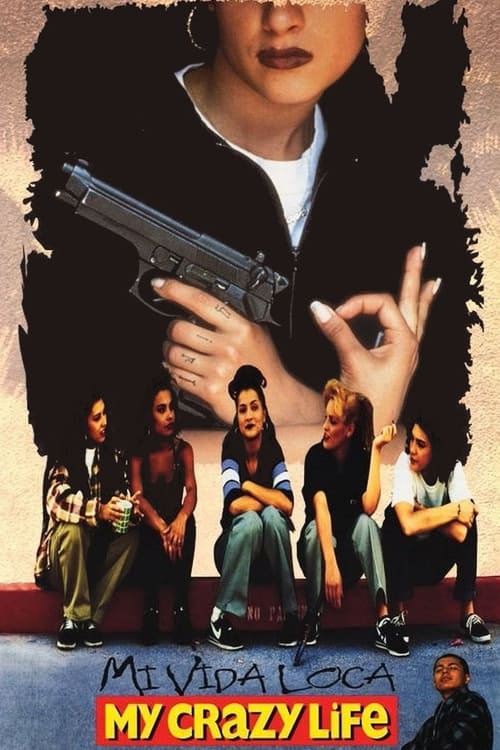
You could make a (legitimate!) point that Allison Anders, much like Jennie Livingston with Paris is Burning, probably shouldn't have been the person to make a movie about the Echo Park Locas, but she does so with so much obvious respect for the culture and dedication to authenticity that I don't think that criticism is totally fair. Can you even imagine what some Tarantino-lite hack would've done with the same subject matter?
Mi Vida Loca is one of the purer expressions of what it is to be Mexican-American. Not everyone came up in East LA, and not everyone is a gangbanger, a statement that feels obvious but I guess needs to be made. The story of communities in America is generational, and this is a story of how even five years in an age cohort makes a huge difference in how the world looks, interior and exterior. It’s also a necessary counterpoint to the predominant gang narrative that underpins a lot of Chicano film. The viewpoint jumps around, as fitting for a story that is mostly centered around a place and its people, but our spiritual anchor is our first protagonist, Sad Girl (Angel Aviles), square in the middle of things. Hers is a generation barely out of school age, and already dealing with raising the next generation with little in the way of financial prospects. Guiding them are not their parents, old enough to be separated by language and culture, but the neighborhood OGs, people in their late twenties and thirties who have survived and either gone mostly straight or are fresh out of prison. It’s through Sad Girl’s perspective that the gangster life is presented in a more rounded version. She and her homegirls participate in the carnage themselves, and it’s important to note that moralizing aside, violence is a way of life in some places whether one likes it or not. Some have a knack for it, and there’s a perverse glory in that which comes across in most crime stories. That’s here too, but the cost is almost never fully realized, and Allison Anders is on that. Sad Girl and her comrades are the ones that get to bury the young hotheads, and the ones who get to raise their now-fatherless children. The goofy custom truck that serves as our McGuffin here is a Rorschach blot; the preening vatos see a status symbol, and the ever expanding council of young widows sees a way to pay for diapers and formula. The true consequences, as well as the comaraderie and the little sparks of glory, of what it means to come strapped are documented here. Whisper, not even eighteen and crippled by gunfire, still bright and shiny with her talent for overseeing a drug operation, just breaks my heart. The most satisfying parts of this are the most bittersweet, those moments we get with the prematurely old residents of Echo Park. Big Sleepy and Giggles finding each other after the latter is done with a four year stretch is a lovely interlude, a long-simmering romance finally being allowed to bloom between two people with great screen chemistry together. Both have seen enough of the violence on the streets and the cost to be done with the game, and both now face the flattened arc of the rest of their lives. And both are pretty damaged for that knowledge. Giggles might be the most heartbreaking character of all, coming out of prison and held in utter disdain by the younger set, chasing a dream of a career that seems absolutely impossible to achieve on the heels of a felony conviction. It doesn’t make her moments with Sleepy or her tender interactions with her daughter any less sweet. Latino viewpoints in American cinema are pretty rare, and female viewpoints within that subset rarer still. It’s a good thing Anders makes so much out of an inexplicably scarce opportunity to tell a story like this.The 11s: Chicano Film