




Just a moment...Enable JavaScript and cookies to continue
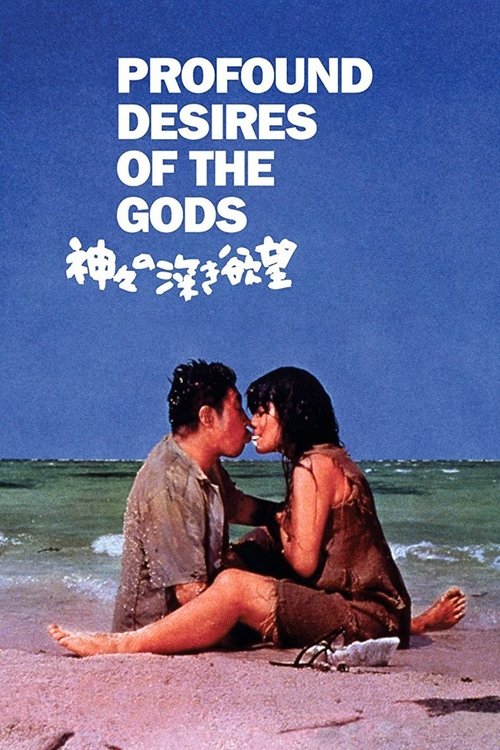
Tokyo engineer Kariya arrives on a primitive tropical island, where he interacts with the Futori clan, to drill a well to power a sugar mill.
Profound Desires of the Gods isn't screening in cinemas right now.
Follow the film in the app to get notified when showtimes are added.
Profound Desires of the Gods showtimes, refreshed every morning
Pick your cinema, get a nudge before it leaves screens.
Just a moment...Enable JavaScript and cookies to continue

Extraordinary images and allegorical representations of the human condition and its fragility abound in Imamura's first color metaphysical mammoth. Extraordinary in its ability to be absorbing at its core, and with a haunting fusion of cinematic styles that range from surrealism to images of nature that mimic a documentary style, Imamura's analysis of the invasion of civilization over a secluded tropical island pervaded with Pantheistic philosophy is a truly entrancing juxtaposition of themes, rhythms and styles as varied as the unpredictability of life itself. Illusion and reality are combined but exclusively through the eyes of the Futori family, rather than the engineer, who symbolizes the side that announces "rationality" as the medicine for modernity, despite the fact that there is an inherent irrationality in declaring rationality as entirely proper in its application over all life areas, dismissing the undeniable emotional human component.Painting primitiveness with tones of aggression and beauty, placing the camera as an omniscient god capable of adopting multiple perspectives, from an eagle-eye judging divine presence to subtly and coldly calculated invasive minimalism, Profound Desire of the Gods is an entrancing examination of reality vs. fantasy, beauty vs. ugliness, rationality vs. emotional impulse, tradition over modernity, and superstition vs. psychological atheism. Epic in its ambition and duration, this is potentially the director's best film, as well as his most complex reflective dissertation of life.94/100

1st Shōhei ImamuraDon’t be deceived by Letterboxd’s plot summary. This isn’t Woman of the Dunes transported to a tropical island. This is a Zola novel with all the mud, blood and mechanisation that entails. Brother God and Sister God making the island has degenerated into the crazed Nekichi and his sister Uma playing Sisyphus and Cassandra, enveloped by their squalor and greed. But questions about incest as prepotency or destiny aren’t on Imamura’s mind. See it as a metaphor for the decay of the old order, with all the European royalty innuendo, and you’re in the right ballpark. The encroachment of industrialisation on the island represents not the cathartic destruction of archaic tradition but one hegemony hollowing out the other and using its skin. Religion becomes a charade to perpetuate economic growth that only fattens the elder’s pockets, not that they live long enough to enjoy it. But to Imamura’s credit, Gods and Globalisation are never binaries. The arrival of the airport may sound the death knell of the remote island paradise, but it also ends the influence of a malignant older generation withering on the vine and choking the life out of its children. That ambiguity extends to the engineer’s relationship with the island. He may seem like Abe’s helpless insect collector as he vomits off the side of the island’s only boat but his bespectacled bemusement masks a man who becomes perfectly willing to enjoy the charms of a “simple” island and then escape home scot free. He is both exploiter and exploited, though with the nauseating luxury of denying his sexual misdeeds to his wife’s face at the film’s end.If Profound Desires of the Gods offers no clear way forward for the reconciliation of the ugly old and the brutal new, no matter. Imamura seems more interested in how two predators interact when put in the same rock pool, and the results are fascinating, from a scientist perspective. Zola would be proud.
A Tokyo engineer arrives on a primitive tropical island to drill a well and becomes entangled in the complex traditions and taboos of the local clan.
Shōhei Imamura directed the 1968 Japanese drama, known for his anthropological and ethnographic approach to filmmaking.
Profound Desires of the Gods is rated 15+ in Czech Republic.
Profound Desires of the Gods was released in Japan on November 22, 1968.