films fait par et pour les occidentaux, beaucoup trop gentil, pas assez politique. Les personnages sont seulement là pour représenter des situations, les femmes du club de lecture n'existent pas en tant qu'individu propre. On accorde à chacune 5 minutes de dialogue intime à l'écran, puis on passe à une autre sans jamais remettre le sujet sur le tapis le reste du film. Après voilà, y'a de la bonne volonté, ça veut bien faire, donc je vais pas non plus pourrir le film
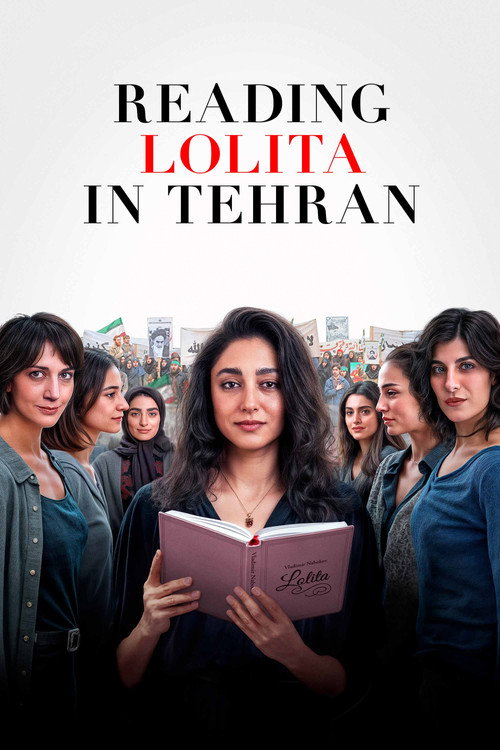
This film falls short of its rich source material. It wants to be about literary freedom, gender oppression, and political resistance but only skims the surface of all three. Moments that should hit hard—intimate scenes of women reading Lolita as part of an “underground” book club—feel underdeveloped, stilted. The intellectual back-and-forth between Nafisi and her students, which should be the heart of the story, often feels clumsy. Seems like a direction issue. The film rushes through ideas (“I am thirty-five and don’t know what love is”) instead of sitting with them, like it’s afraid of—or conflicted about, or just uncommitted to—its own depth. The pacing undercuts the story. Much of the movie ends up feeling like a chain of disjointed moments.Then there’s the setting. Sure, filming in Italy instead of Tehran was was a logistical decision, but it makes everything feel oddly artificial. It’s hard to stay in the story when you’re constantly aware that it’s a set. So many scenes feel… “placed”.The bigger question: why was an Israeli director—especially one who supports a two-state solution—the one to tell this story? Riklis has a reputation for “measured” approaches to political conflict, but Reading Lolita in Tehran isn’t about two sides trying to navigate coexistence (if such a story even exists). It’s about a government’s oppression of its own people. That kind of story needs a different approach, a different kind of storyteller—one with no interest in compromise. An Israeli film about Iranian repression is going to carry a political charge, regardless of intent. This movie plays into a broader Western narrative of Iran as a uniquely oppressive state. That’s not to say Iran’s government isn’t repressive—it absolutely is—but the film’s silence on the role of the U.S. in creating the conditions for that repression is... loud.There’s no mention of Mosaddegh, Pahlavi, or the mission that overthrew the former and installed the latter. No acknowledgment that the revolution was, at least in part, a response to decades of Western interference. I don’t claim to be a history buff or foreign policy staffer. Not my speed, sounds like subscribing to a never-ending quiz on the entire world. However, it feels particularly ham-fisted and, simply, wrong, for a film to condemn the Islamic Republic while ignoring how American foreign policy helped bring it to power in the first place. Given the alliance between the U.S. and Israel, it all feels less like an oversight and more like selective storytelling.Reading Lolita in Tehran wants to be a powerful, layered exploration of resistance and repression, but it never quite gets there. It’s limited artistic shortcomings, uncomfortable geopolitical baggage, and some glaring historical omissions. That said, there are poignant moments—largely thanks to the strength of the source material and Farahani’s performance (even if she somehow doesn’t age over 25 years). I really wanted to be moved by this movie, but in the end, it just feels incomplete—like it’s been filtered through too many layers of distance, competing interests, something—to actually resonate.Anyhoo, I don’t even remember the last time I wrote for fun! Still got it!