




Wim Wenders associated soccer with murder 50 whole years before FIFA & Qatar did.
We use cookies to personalize your experience and analyze traffic. You can opt out at any time.
Directed by Wim Wenders
Die Angst des Tormanns beim Elfmeter
A bleak, atmospheric drama.
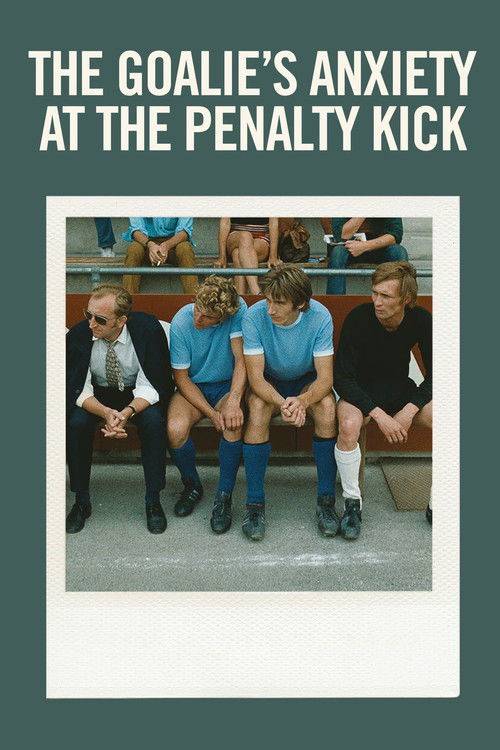
Goalkeeper Josef Bloch is sent off after committing a foul during an away game. This causes him to lose his bearings, and he wanders aimlessly through the city streets and spends the night with the box-office attendant of a movie theatre.
The Goalie's Anxiety at the Penalty Kick isn't screening in cinemas right now.
Follow the film in the app to get notified when showtimes are added.
The Goalie's Anxiety at the Penalty Kick showtimes, refreshed every morning
Pick your cinema, get a nudge before it leaves screens.


Wim Wenders associated soccer with murder 50 whole years before FIFA & Qatar did.

to do this day i’m still perplexed of wender’s statement during berlinale 2026 and how filmmakers should “stay out of politics” when his first film festival feature-length debut (at least in IFFR) bleeds off of it. even the story of a goalkeeper isn’t just isolated to sports but also a reflection of its time that is tense and bruised from multiple wars and conflicts that it disconnect individuals from meaning and purpose in a land modernizing with haste. which in itself continues to be relevant today where certain regions overindulge and live in complete ignorance while others are deprived of even the right to live another day.

After being sent off for angrily contesting a goal as offside, goalkeeper Josef Bloch (Arthur Brauss) wanders aimlessly through a strange town, visiting the local cinema and picking up the attractive blonde cinema cashier. Following their night of passion, Bloch arbitrarily strangles her to death, before boarding a coach to visit an old flame in the quiet village on the East/West border of (I think) his birth. This somewhat overlooked 1972 film from Wim Wenders has been taken off the shelf, dusted off and restored and given a cinema release and it's an existential delight that owes much to Albert Camus' classic 1942 novel L’Étranger and to Camus' own previous occupation as a goalkeeper with Racing Universitaire d'Alger. Our protagonist has the same emotional detachment as Meursault, the man who felt nothing at his mother's death and who goes on to kill a man in the novel by Camus. Just like him, we're given no explanation for Bloch's homicidal behaviour or why he neither feels nothing at the sight of the body of a missing schoolboy, nor reports his findings to the police. Equally, the indifference he shows to his future goes without explanation too. The closest we get to it is in the film's final moments, when the meaning of the title becomes clear. In this scene, Bloch is watching a football match and strikes up a conversation with another spectator, a travelling salesman who, like him, is just passing through the town. Bloch tries to explain what he feels about football from the goalie's perspective, specifically the dilemma he is presented with regarding which way to go each time he faces a penalty. This dilemma is one that the village's policeman shares with Bloch in a late night conversation regarding having to second guess which way an offender is going to run. For Wenders, the moment between the goalie and the opposing player is a psychological confrontation and it serves as a parallel to Bloch's current situation: he hasn't gone on the run, isn't sure or indeed seemingly all that concerned about the possibility that the police may be on his trail, he is just existing from day to day in plain sight, feeling nothing once again. It's easy to see why Wenders would go on to so successfully adapt Ripley's Game as The American Friend in 1977, as Bloch is very much cut from the same cloth as Patricia Highsmith's literary anti-hero.It's not all heavy existential ennui though; there's a fine streak of bone-dry humour playing out across the film that allows Brauss' otherwise murderous impassive demeanour the opportunity to afford this comic relief with a winning deadpan reaction. However, I could have done without the excessive use of Jürgen Knieper's monotonous score as it really rather began to grate, though I think that perhaps added to the stifling nature of the slow, introspective narrative.A quick note on the cinema experience itself: Watching this this afternoon I was reminded why I don't really go to the pictures all that often any more. I was at Fact Picturehouse, which is normally quite reliable and a cut above the usual multiplex experience, but Tuesday seems to be their senior citizen day and, as this is the only showing of the film, I didn't have any choice other than to sit and listen to a chorus of coughing and muttering throughout the duration. I was amazed to see that people were still coming in to watch the film a full half hour after it had commenced and the screening room itself was at sub arctic temperatures. I really do feel that such an experience impacts on your appreciation of whatever film it is you're watching.
After being ejected from a soccer match, a professional goalkeeper experiences a breakdown of reality and identity, leading him to wander aimlessly and commit an inexplicable crime.
The film was directed by Wim Wenders in 1972, serving as a landmark debut for the New German Cinema movement.