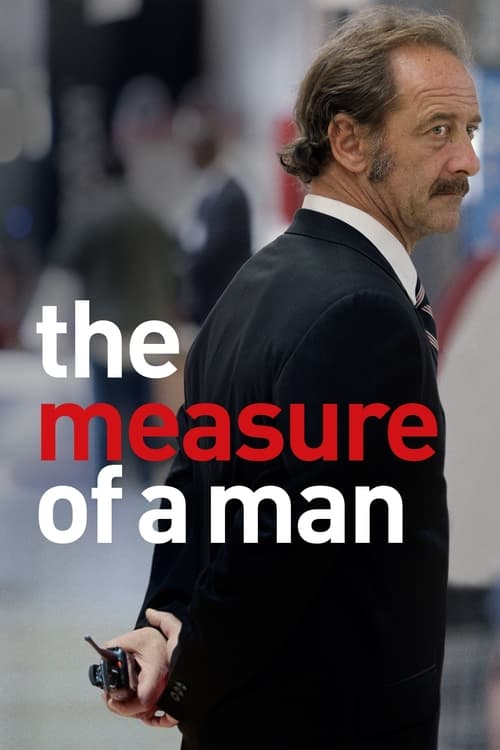
The Measure of a Man is not a film that will be lauded for its direction nor for its cinematography, screenplay or editing. It’s a film that will be remembered for its absorbing lead performance. Vincent Lindon takes one deep into the mind of Thierry, a man who has recently lost his factory job and is now trying desperately to find work. Unfortunately, obstructions of the modern world, from the current state of the economy to the introduction of technology in the workplace, prevent him from doing so and thus he struggles to support his family financially.After impressing in Claire Denis’ recent atmospheric thriller, Bastards, Lindon goes to greater lengths here, deeply sinking into his role and displaying Thierry’s very human vulnerabilities and weaknesses. Directed by France’s Stéphane Brizé, The Measure of a Man manages to be a merely capable Dardennes-esque social realist piece of filmmaking, but Lindon’s performance is perhaps the finest of this year’s festival.Aside from his performance, there are other elements to appreciate within its overt commentary on how difficult it can be to find and maintain a job in the contemporary economic climate. While this was a fitting skeleton for the film’s message, its peripheral commentaries and the ability to hint at factors beneath the surface of the plot is where the film excels. Reminiscent of Andrea Arnold’s 2006 film, Red Road, it argues that technology (e.g. video surveillance footage) plays an important role in the protagonist’s daily activities and the ultimate outcome of their story.As Thierry navigates his way from interview to interview, he is sometimes forced to conduct them via Skype, a means of communication that he seems uncomfortable and awkward to be engaged in. A particularly memorable albeit frustrating scene shows a group of individuals watching one of Thierry’s practice interviews; when the interview concludes, each person in the room takes a turn harshly critiquing Thierry on some aspect of his “performance,” from his body language to his posture to his tone. It’s a tough scene to endure, but through Lindon’s complex facial reactions, the scene is transformed from an irritating experience into an absorbing one.Another below-the-surface implication that is captured is the film’s portrayal of families. The more one finds out about the families, the more is understood about how desperate these people are to pay their bills, and the extent to which they will risk their well-being in order to support the ones they love. Thierry is the clear example of this as a man who one unquestionably roots for throughout the duration of the film once we come to understand the true reason why he is so desperate for pay: his son is disabled. However, the true ethical dilemma in the film arises when a tragedy results from a morally questionable attempt by one of Thierry’s co-worker’s to help her drug-addicted son. The result of this tragedy forces Thierry to make a decision, one that he struggles with until the strong final moments.The Measure of a Man wears its influences on its sleeve, but never attempts anything that the Dardennes didn’t already with their great ‘90s works, Rosetta and La Promesse. In fact, much of this film feels like an updated version of Rosetta, rather with a older male lead. Brizé creates such an exhausting experience, with Thierry being constantly beaten down by his working class environment, that it could’ve been slightly tighter as the ordeal begins to feel repetitive. Rather than existing to entertain, this is a drama that performs as a mirror in an attempt to recreate life and portray the struggles of the working class. While it may not bring a great deal new to the table, its central performance is one not to be missed.thefilmstage.com/reviews/cannes-review-the-measure-of-a-man/
[6]I've always found it interesting and a little odd that Harun Farocki worked with Christian Petzold on so many of his recent features, because on their surface, those films -- The State I Am In, Ghosts, Barbara, and Phoenix -- don't bear much resemblance to the documentaries and essay-films for which Farocki is known. This means nothing in itself, of course. Farocki was a versatile artist, and working with Petzold no doubt allowed him to explore different parts of his creative personality, such as his extensive cinephilia. But all other things being equal, if I were to imagine what Farocki's fixations and sensibilities might look like as applied to a narrative film, the result would strongly resemble The Measure of a Man, a work whose original French title, La loi du marché, captures both its subject matter and its eerily Farockian undertones more precisely. Colloquially, the title is a purely economic statement: "the law of the market," the usual laissez-faire self-justification for whatever hardships the free enterprise system doles out. Unemployment, low wages, factory closures, all of these things are regrettable, we're told, but we can never disrupt the Law of the Market. But there's an unexpected pun at work in writer-director Stéphane Brizé's title (and I will confess, I am not 100% certain that it works in French). Our protagonist, Thierry (Vincent Lindon), 18+ months after losing his job as a machinist (the company folded), takes a position as a store detective in a Cora hypermarket, watching monitors and questioning shoplifters. He literally becomes The Law of the (Hyper) Market.However this is not to say that Brizé's English title is inapposite. The first half of The Measure of a Man shows Thierry working through the French unemployment system, a well-meaning but bureaucratically feckless process. It is this half of the film that seems most directly inspired by Farocki's documentary style. We see Thierry undergo a job interview over Skype, only to be curtly informed by the interviewer, "You should know, you will not get this." Then the interview continues, pro forma, for two more excruciating minutes. Later on, a group session at the unemployment agency analyzes a videotape of a mock interview by Thierry, and the other members (all presumably required, like Thierry, to participate in this session by law) proceed to critique Thierry's manner of presentation. He doesn't say "hello." He doesn't wear a closed-collar shirt. He fidgets. He seems cold. He doesn't ask enough questions. In short, the group assesses him on a micro-biological level as if he were a potential Tinder swipe, emphasizing that Thierry's knowledge and experience are secondary to his semi-intangible "it factor." This is a subject that Farocki explored in his 1990 essay film How to Live in the Federal Republic of Germany, and observed in a more straightforward manner in his 1996 documentary Interview. These films, like Measure, are about the minute processes of bodily control that characterize the neoliberal workplace. Usually, they are offered with a smile, as "helpful hints."Once Thierry takes the job at Cora (one of several European hypermarket chains -- in the U.S., our closest equivalent is Meijer, but the concept never really took hold over here), he becomes party to another form of social control. As Brizé takes great pains to show us, every square centimeter of floor space in these stores is under surveillance. The unfinished rail-and-girder ceilings of the warehouse architecture even allows for mobile cameras that can glide along tracks, controlled by remote joysticks within the security command center. We see Thierry being trained not only on the policies and practices of store security, but on basic legibility. How can one make sense of the space of the massive store, the huge multi-channel bank of monitors, and all of the various shoppers who are moving targets in a war against "loss"? Thierry is expected to be a technocratic eye in the sky, something between an air traffic controller and a drone pilot.These segments, in which we are instructed along with Thierry about the extent of surveillance within private property, and our location inside its matrix, are again highly Farockiesque. His narrower examinations, such as The Creators of Shopping Worlds (2001), and his broader philosophical rumnations of vision and power -- Images of the World and the Inscription of War (1989), As You See (1986) -- come immediately to mind. It's only when Measure starts to deal with actual shoplifters that things get weird. Brizé doesn't seem to know how to handle these one-on-one confrontations. They escalate in a rather elementary, Film School 101 manner, from the aggressive, defiant "thug", to the pensioner on a fixed income who is stealing out of hunger. Soon, Thierry is forced to turn on his co-workers, as both he and they are caught in a scheme by the company to thin out its employee rolls for minor transgressions. Thierry and his family depend on this job, but he is being asked to do rather unconscionable things. From beginning to end, the steady build in each scenario's outrage quotient seems jury-rigged to produce a rather canned ethical crisis, with only two options. I will refrain from spoiling the ending, though I will note that every cinematic cue indicates that Brizé expects us to read it as a triumph of human decency. But look closer, and consider its broader ramifications (or lack thereof). Two Days, One Night this is not, and while Stéphane Brizé exhibits a great deal of promise, he still has a ways to go before approaching Dardennes Level. That's a tough standard, sure, but it doesn't seem out of the question that Brizé might one day be a man of that measure.