Paros has two structurally different summer feasts: the August 15 procession of Ekatontapyliani down to the harbour, in one of the oldest surviving Christian basilicas in Greece, and on August 23 the re-enactment at Naoussa of a specific Ottoman raid of 1537 - a form of feast found nowhere else in the Aegean.
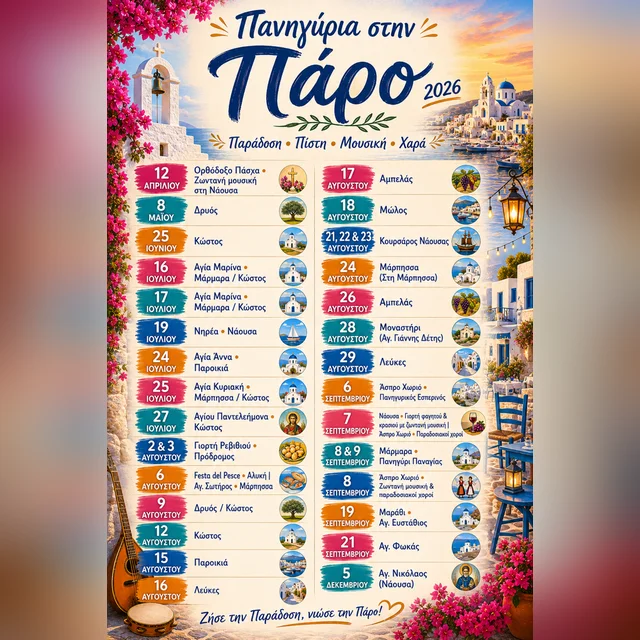
Panigiria · Paros
May - September
Panigiria run from May to September, and the season peaks at Dekapentavgoustos - the Dormition, on 15 August - when most villages hold their feast. Each programme is set close to its own saint's day, so the list fills late and empties out of season.
Ekatontapyliani in Parikia - one of the oldest surviving Christian basilicas in Greece - is the site of the island's largest feast on August 15: the icon of the Virgin is carried through Parikia down to the harbour, the boats are lit up, fireworks are set off, and traditional music and dancing run until dawn. The August 23 feast at Naoussa is structurally unlike any other Cycladic panigiri: it recalls the Ottoman raid of 1537 by the admiral Hayreddin Barbarossa, in which the women of Naoussa were abducted. Locals dress as pirates and villagers; boats arrive from the sea to re-enact the attack. The link to a specific recorded historical event - not a myth, not hagiography - makes this panigiri unique in the Aegean.
The traditional panigiri instruments on Paros are the tsampouna (goatskin bagpipe), the doubaki (a small drum that accompanies the tsampouna) and the violin. The tsampouna nearly disappeared in the middle of the last century; the Cyclades prefecture funded revival gatherings from the 1990s and a new generation of players emerged. Each village holds its own feast: the Karavolas Festival at Lefkes (the first Saturday after August 15) serves large snails cooked with wine and rosemary; Agios Ioannis Prodromos in the village of Prodromos on June 23-24 includes the Klidonas custom, in which the May wreaths are burned on bonfires and participants jump the flames; Agios Fanourios at Ampelas on August 27 centres on the fanouropita cake. The Naoussa Parou dance group (founded 1988) took second place at an international competition in Wales in 1991.
The Pirate Festival at Naoussa, on August 23, recalls the 1537 raid by the Ottoman admiral Hayreddin Barbarossa, in which the women of Naoussa were abducted. Locals dress as pirates and villagers; boats arrive from the sea to re-enact the attack, followed by fireworks and dancing. It is reported as the only panigiri in Greece based on a specific recorded Ottoman raid rather than a saint's feast.
On August 15 (the Assumption), at the basilica of Ekatontapyliani in Parikia, one of the oldest surviving Christian basilicas in Greece. The icon is carried in procession down to the lit-up harbour and the celebrations continue all night with traditional music and fireworks.