
All events in Ioannina
Panigiria Near Ioannina
The Epirus panigiri is first of all a homecoming: in August the villages fill with emigrants returning for the feast, the klarino opens the dancing and the glenti runs into the early hours. On August 15 twelve Zagori villages celebrate at the same time.
Find eventsAsk Mood
Panigiria · Ioannina
May – September
Panigiria run from May to September, and the season peaks at Dekapentavgoustos - the Dormition, on 15 August - when most villages hold their feast. Each programme is set close to its own saint's day, so the list fills late and empties out of season.
Panigiria in other cities
Panigiria Near Ioannina
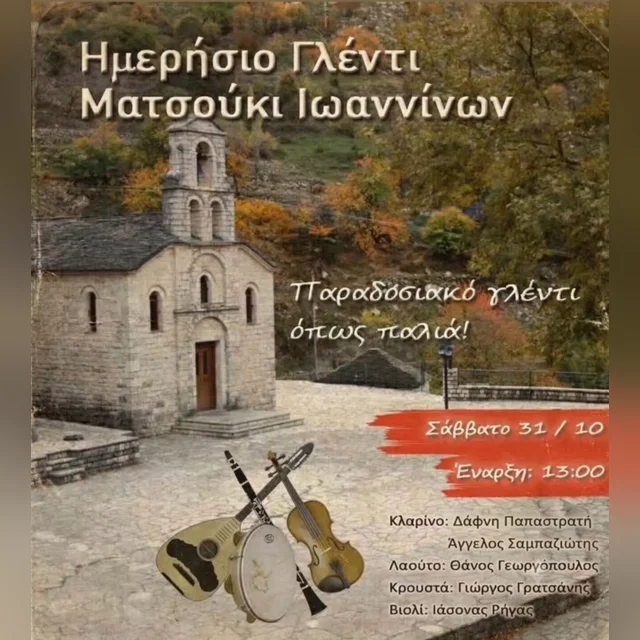
The Epirus kompania - the ensemble that plays the panigiria - rests on four instruments: klarino (Greek clarinet), violin, laouto and defi (frame drum). The klarino is identified with Epirus more than with any other region of Greece, and the Epirot repertoire includes forms that are not for dancing: the moirologia, played instrumentally, and the skaros, the shepherd's melody. The summer calendar peaks on August 15, when twelve Zagori villages celebrate simultaneously and the region lives in a state of continuous panigiri. The Epirot panigiri works as a diaspora reunion: villages with few permanent residents receive hundreds of returning emigrants each August - at Foteino (Zelitsa) near Ioannina, over 500 people from across the country are recorded.
Epirot polyphonic song is the deepest layer of the region's musical tradition and is distinct from the kompania panigiri: it is sung without instruments, in groups, in a distinctive polyphonic structure, and survives in the villages of Pogoni and among the Greek minority in Albania - it is one of the most significant examples of polyphony internationally and is recorded on Greece's National Inventory of Intangible Cultural Heritage. The patron of Ioannina is Saint George of Ioannina, the 'Foustanelas' (1808-1838), a neomartyr hanged in the city on January 17 1838, the eve of the feast of Saint Anthony; his memory is honoured on January 17 and the translation of his relics on October 26.
Common questions
When are the Epirus panigiria held?+
The peak is August, when the emigrants return. On August 15 twelve Zagori villages celebrate at the same time, with the klarino carrying the glenti into the early hours. Villages with few permanent residents receive hundreds of visitors - at Foteino near Ioannina, over 500 people are recorded.
What instruments are played at Epirus panigiria?+
The Epirus kompania consists of klarino, violin, laouto and defi, with the klarino as the lead instrument. The repertoire also includes non-dance forms: the moirologia, played instrumentally, and the skaros. Separate from the kompania stands Epirot polyphonic song from Pogoni, sung without instruments and recorded on the National Inventory of Intangible Cultural Heritage.